

Clean Cooking for All by 2030: The Gap Has Shifted
In 2010, seven in ten people living in Asia did not have clean cooking solutions. Today, half of those facing lack of access to clean cooking live in Africa, and by 2030 could rise to about seven in ten. Our latest analysis of the 2026 Tracking SDG7 data shows that the clean cooking gap has shifted, and that Asia's progress shows how to close the gap.
2 bn
without clean cooking in 2024 (approx.)
70%
of the gap was in Asia in 2010
50%
of the gap was in Africa in 2024
70%
of the gap is projected in Africa in 2030
1.6 bn
projected without clean cooking in 2030
Why clean cooking matters
2.9 million. That is the World Health Organization's latest estimate of deaths caused by household air pollution in a single year in 2021, including more than 309,000 children under five. Most of that pollution comes from cooking on open fires or inefficient stoves with wood, charcoal, dung or kerosene. Women and children bear the greatest burden, and are disproportionately affected by indoor air pollution.
~2 billion. That is how many people still lacked clean cooking in 2024: about one in four people on Earth.
In 2010, the gap was mostly in Asia
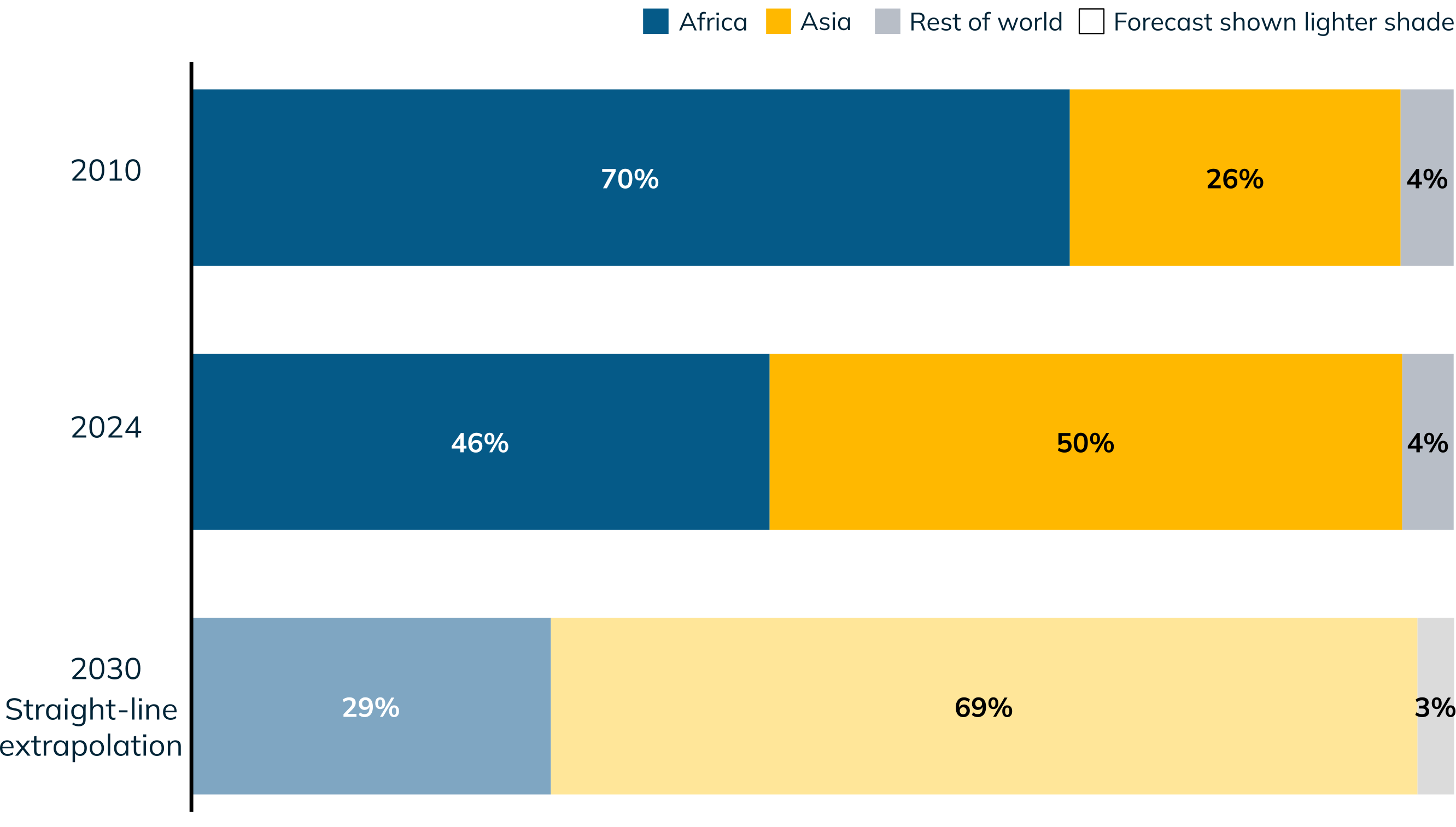
70%. That was Asia's share of the world's clean cooking gap in 2010: about 2.1 billion of the 3 billion people without access. Africa held 26%. Since then, the world has cut the gap by 1 billion people, and its geography has changed with it. Asia now holds 46% of the gap and Africa 50%. On current trends, the two shares will have almost swapped by 2030.
Share of the world's population without access to clean cooking, %
Who shifted it: India and China
94%. That is India and China's combined share of the world's net reduction in the number of people without clean cooking since 2010. India reduced the number by 545 million people and China by 421 million: 966 million combined.
Large-scale national action helped drive this progress. In India, the Ujjwala initiative has provided more than 100 million clean cooking solutions to low-income households since 2016. More broadly, China, India and Indonesia halved their populations without access to clean cooking, largely because their efforts relied on free stoves and subsidised fuels.
Across Asia, the clean cooking access rate rose from 50% to 81%, showing that rapid progress is possible when action is taken at scale.
Where the gap is now: Africa
997 million. That is how many people in Africa lacked clean cooking in 2024, up from 791 million in 2010. In 2023, Africa overtook Asia as the region with the largest number of people without clean cooking.
Population without access to clean cooking, millions
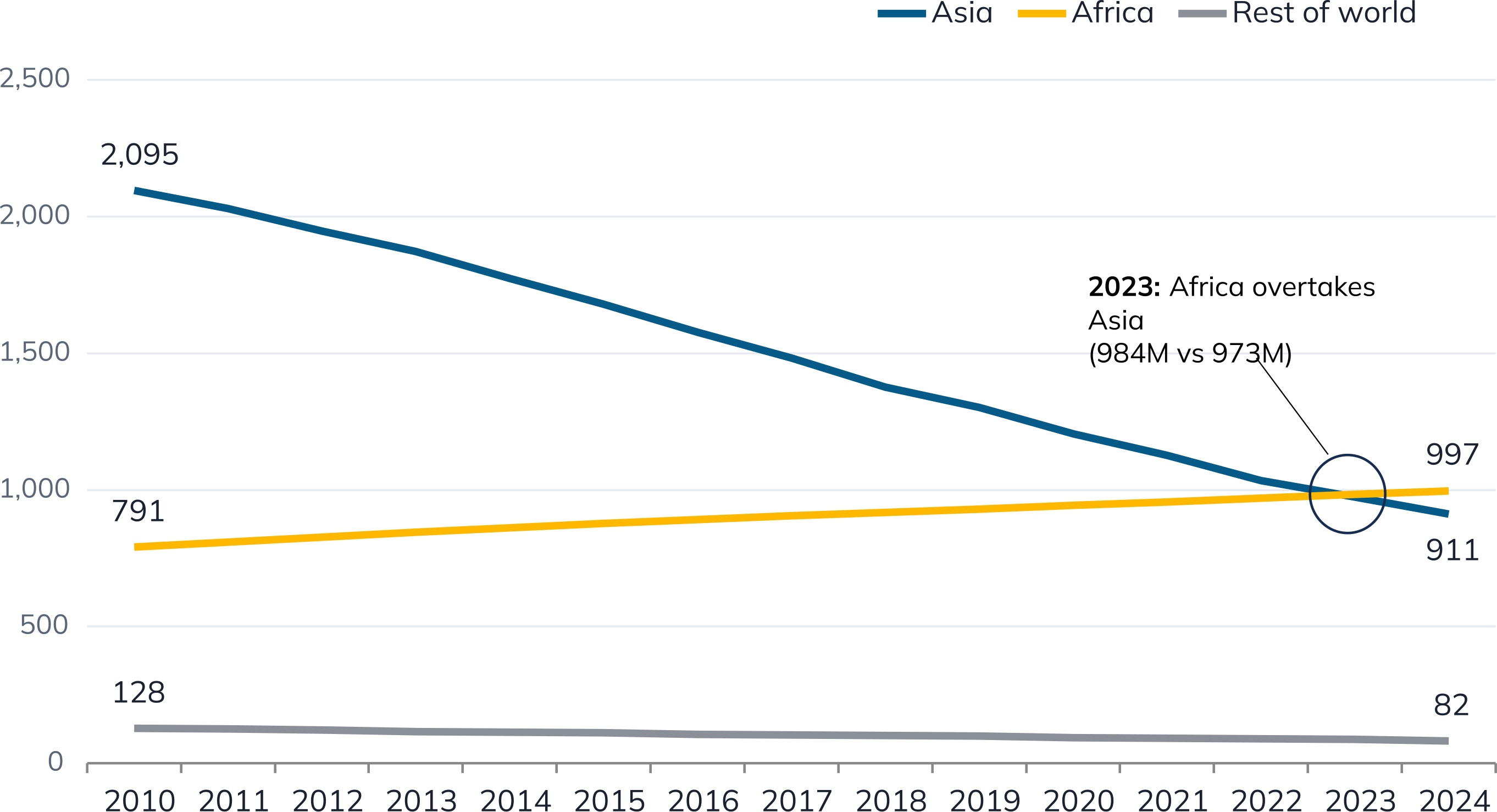
The rest of the world accounts for 82 million people, down from 128 million in 2010: 63 million in Latin America and the Caribbean, 11 million in Oceania and 8 million in North America and Europe. Clean cooking for all includes them too.
Population without access to clean fuels and technologies for cooking1 by region, millions, 2024
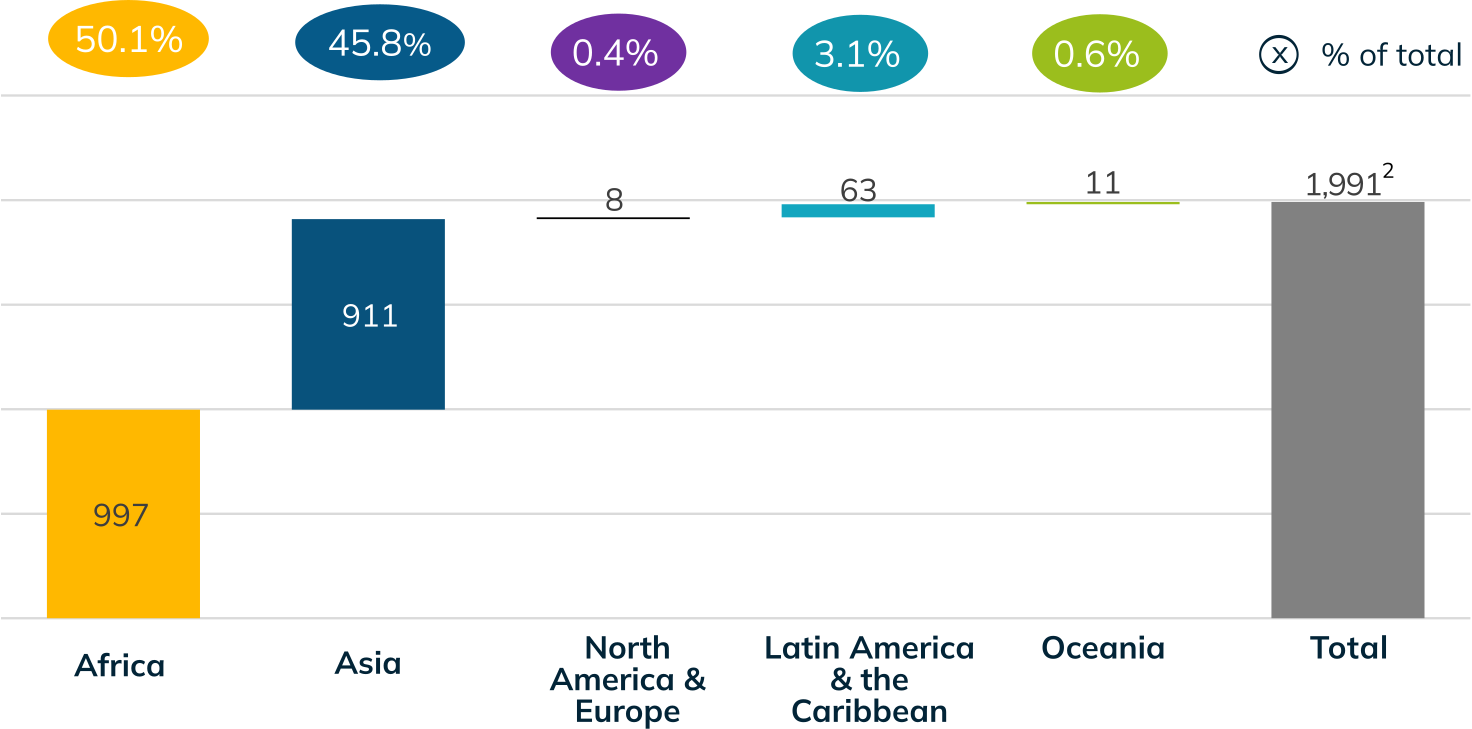
NOTES:1 Clean cooking access is defined as a household using clean fuels or improved technologies for cooking as defined by the WHO2 Country-level calculations were aggregated to regional and world totals. Regional and world totals are the sum of country-level results across the 194 countries with published access rates.
SEforALL analysis. Data Source: Tracking SDG7 2026 Report Dataset; World Bank, Total Population data (downloaded 25 June 2026); World Bank, Population Estimates and Projections data (downloaded 26 June 2026).
Why the gap shifted: population grew faster than access
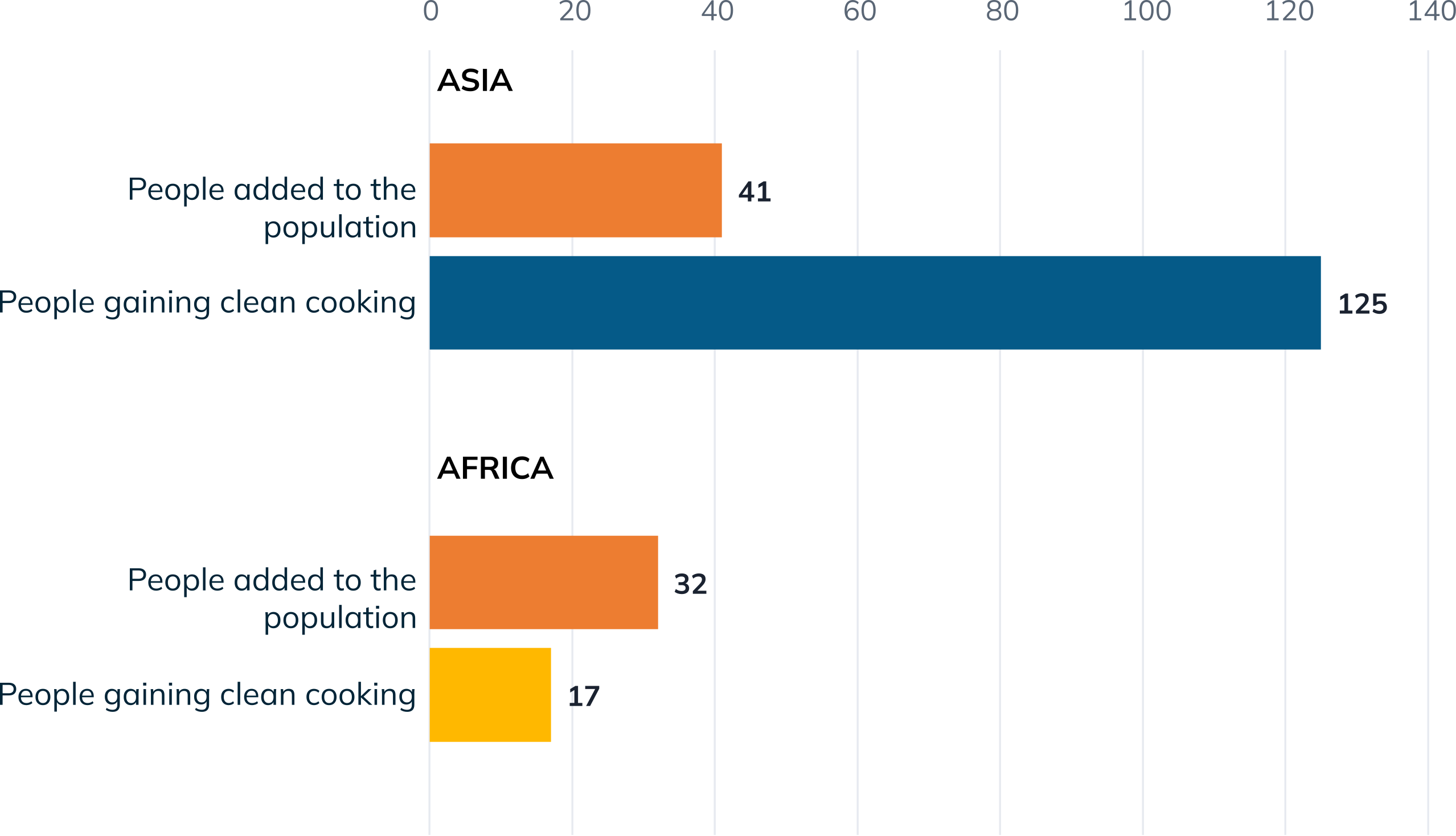
17 million. That is how many more people in Africa gained clean cooking each year, on average, since 2010. Over the same period, Africa's population grew by about 32 million people a year. The number of people without clean cooking can only fall when more people gain clean cooking each year than are added to the population. In Africa, the opposite happened: for every two people added to the population, only about one gained clean cooking access. That is why the number still in need rose from 791 million to 997 million.
Asia shows the reverse. Its population grew by about 41 million people a year, while about 125 million gained clean cooking each year: three for every person added. That is why Asia's gap fell so fast.
Average per year, millions of people, 2010 to 2024
Africa's fast-growing population sets a higher bar, but it does not decide the outcome. Had clean cooking spread through Africa's population as quickly as it did through Asia, Africa's gap would have fallen from 791 million to about 650 million instead of rising to 997 million, even with the same population growth.
Asia's progress is starting to be repeated in Africa
3 countries. Nigeria, Kenya and Ghana have made the fastest progress in expanding clean cooking access among the 12 African countries with the largest access deficits. Together, about 85 million more people in these three countries have clean cooking than in 2010: 62 million in Nigeria, 15 million in Kenya and 8 million in Ghana.
Clean cooking access rate, %, 2010 and 2024: the 12 African countries among the world's 20 largest gaps
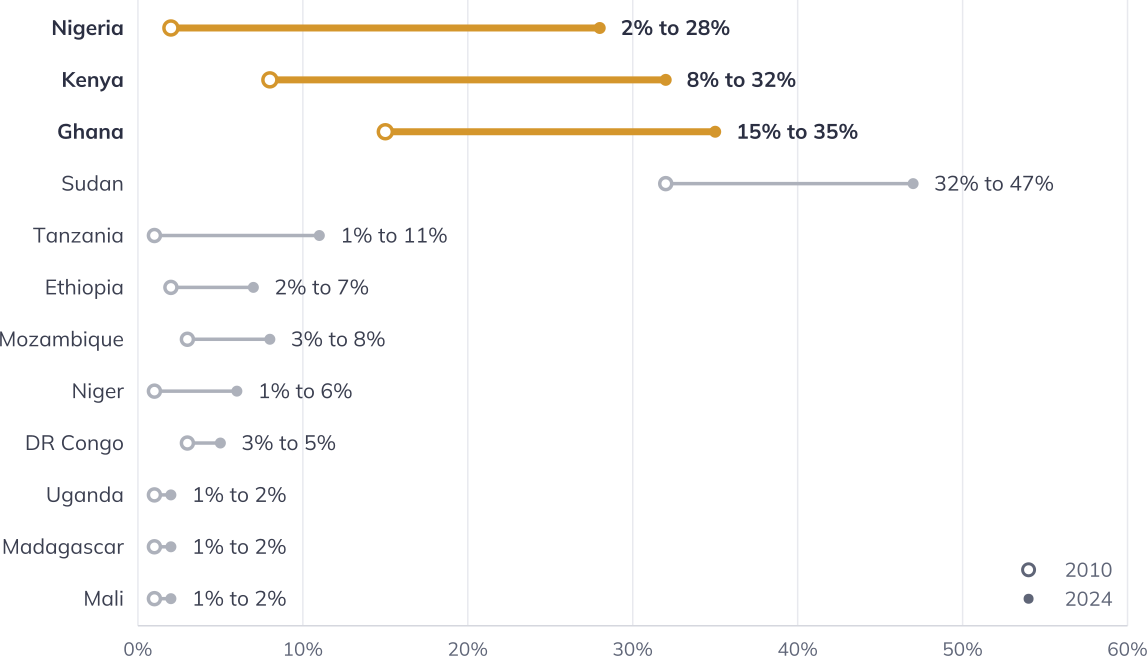
What if every African country had kept pace with Nigeria? If access had risen in every African country by at least as much as it did in Nigeria since 2010, Africa’s clean cooking access rate would be about 46% in 2024 instead of 34%, and about 185 million more people would be cooking with clean fuels and technologies.
On today's trends, the gap keeps moving
1.6 billion. That is how many people will still lack clean cooking in 2030 if today's continental trends continue and efforts are not scaled, and 69% of them, about 1.09 billion, will be in Africa.
Projected population without access to electricity, millions
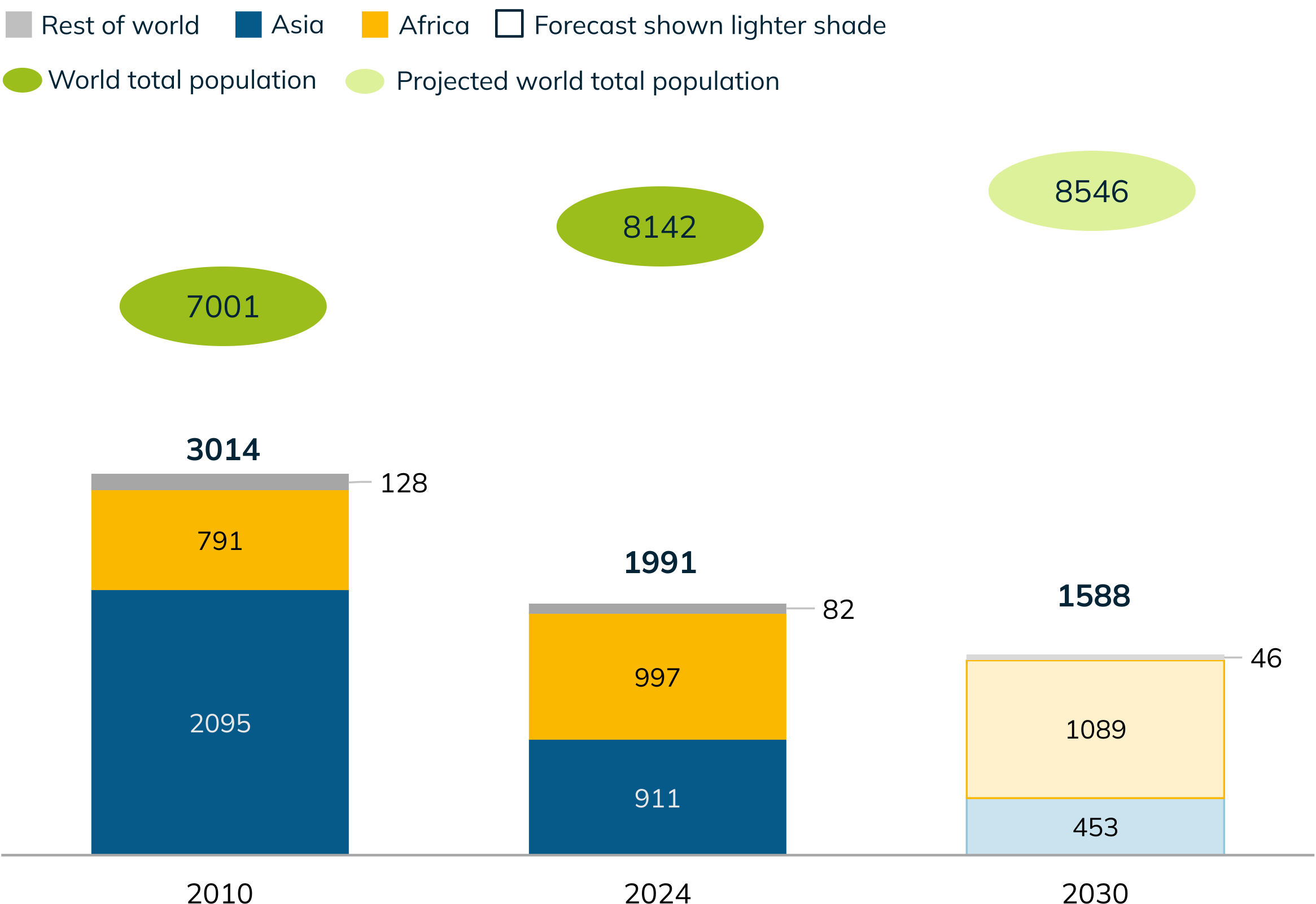
These projections are straight-line extrapolations of today's trends by continent: not a prediction by country of what must happen, but a warning of what will, unless the pace changes.
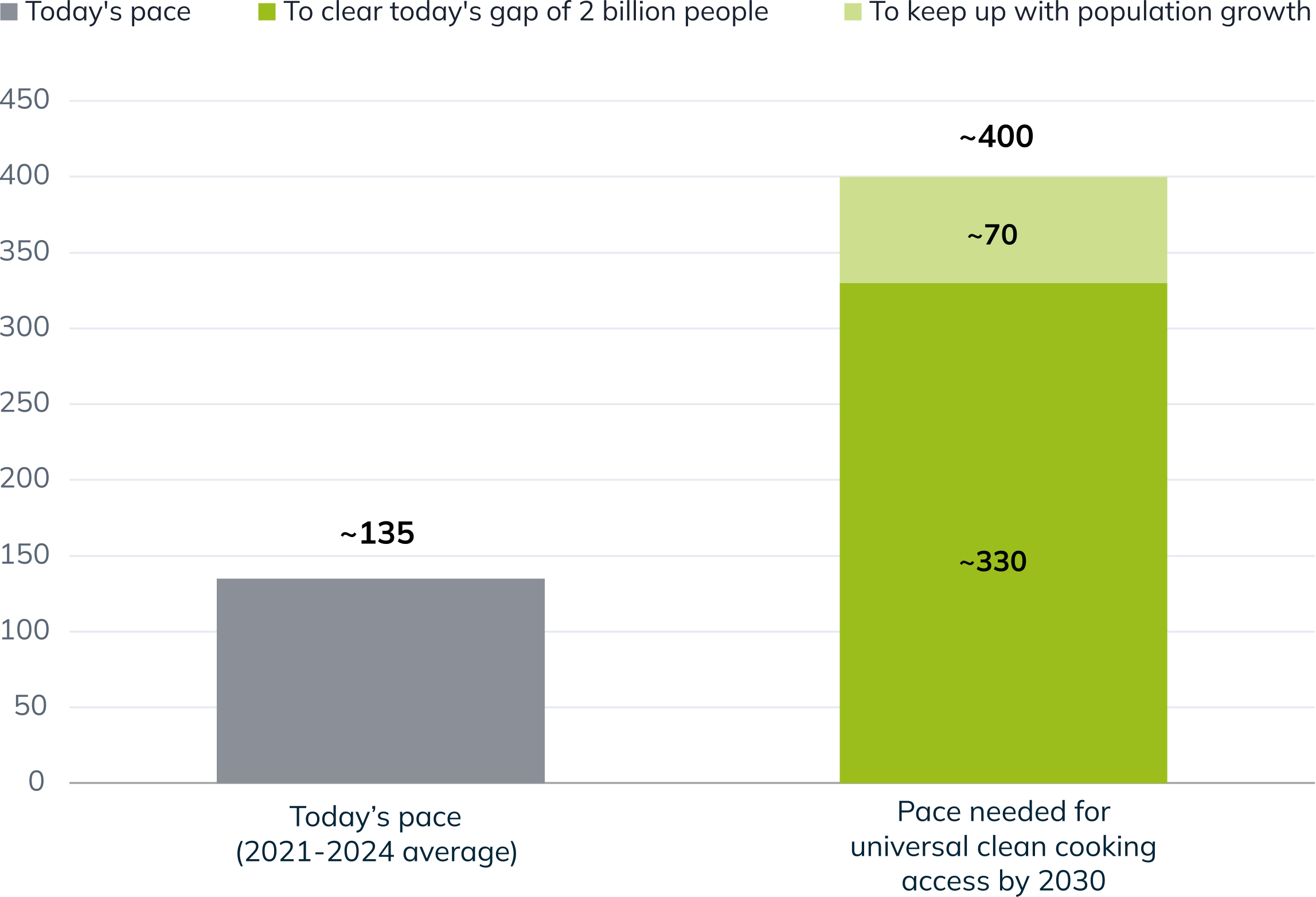
400 million. That is how many people need to gain clean cooking access every year to reach everyone by 2030: about three times today's pace. The effort can be focused, because 20 countries hold 75% of the gap, 12 of them in Africa and 8 in Asia. Investment needs to increase from current USD 2.5 billion to USD 8 billion annually between 2022 and 2030 to achieve clean cooking for all. That is small in context: the Strait of Hormuz crisis added an estimated USD 330 billion to countries’ fossil fuel import bills between March and August 2026. This is more than 40 times the USD 8 billion in annual investment needed to achieve universal clean cooking access by 2030. Less than five days of additional fossil fuel import spending would cover a full year of investment needed for clean cooking.
People gaining clean cooking access per year, millions
The solutions are already at work
Schools and public institutions are the fastest-scaling entry point to advance clean cooking progress. For context, institutions come only second to households when it comes to biomass usage globally.
10 countries. That is where the Platform for Clean Cooking in Schools, launched by SEforALL, the World Food Programme and partners at COP30, is already operating.
The results from school kitchens are encouraging. In pilots in Lesotho, switching to electric pressure cookers cut fuel costs by 27% to 69% compared with LPG, and by about 85% compared with open wood fires. In Tanzania, the first electric school kitchen opened at Kibasila Primary School in Dar es Salaam in July 2025, the start of a programme to reach up to 50 government schools. In schools in Kakuma, Kenya, fuel costs fell by about 26% when improved cookstoves were introduced.
Governments are moving too: through Mission 300, governments are addressing clean cooking in their National Energy Compacts. Together, these compacts cover more than 500 million people. What is missing is pace and finance, not solutions.
The gap has shifted. The effort must shift with it
In 2010, seven in ten people without clean cooking lived in Asia. India and China showed the gap can close fast. What remains has shifted to Africa, where population has outpaced access.
That can change. Nigeria, Kenya and Ghana show early signs of a turn, and solutions are already at work in schools, public institutions, and national energy plans. The task is pace: 400 million people a year need to gain access if we are to meet our 2030 targets.
Clean cooking for all means cleaner air, time back for women and children, less pressure on forests and the climate, and modern energy for everyone. The gap has shifted. By 2030, the effort, the finance and the solutions must shift with it.
Read our full analysis on 2026 Tracking SDG7, and join us in turning momentum into universal clean cooking.
Related content


