
Powering Tomorrow’s Women Leaders: Building the Ecosystem Young Women Need to Shape the Energy Transition
By Monique Elliott, Chief Brand and Communications Officer, Schneider Electric; Lolade Abiola, Chief of Staff, Sustainable Energy for All; and Anna Fälth, Global Head of the Women’s Empowerment Principles, and Head of the Global Supply Chain Coalition Secretariats, UN Women
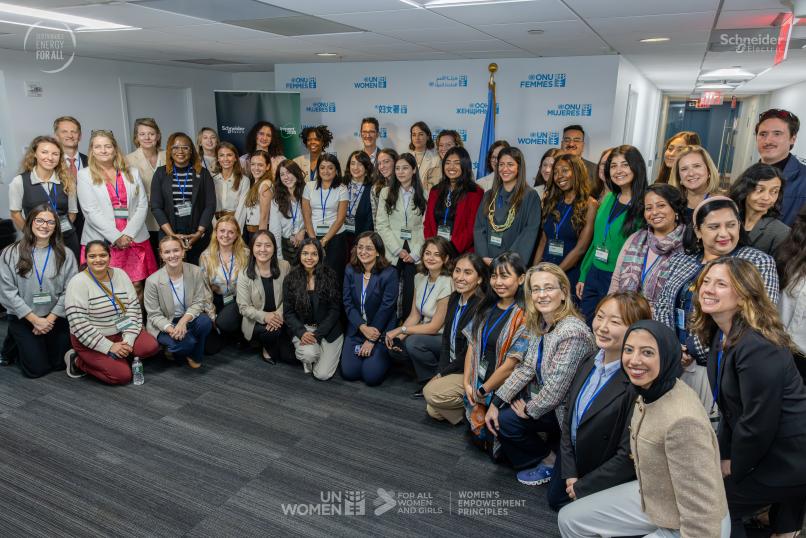
When young women studying, working and building careers across engineering, energy, climate and technology gathered in New York this September, they sat across the table from experienced leaders. But they were not there simply to receive advice. The leaders were there to listen, too.
This balanced exchange of perspectives matters.
For years, efforts to close the gender gap in science, technology, engineering and mathematics (STEM) fields have rightly focused on expanding access to education and technical skills. Those investments remain essential. But access to a classroom does not automatically translate into a career path. Completing a training course does not guarantee that a young woman will have access to the networks, opportunities and inclusive workplaces to become an engineer, entrepreneur, innovator or leader.
Before skills can become opportunities, young women must be able to see a credible pathway into workplaces and institutions that are ready to value their contributions.
For many young women, decisions about STEM begin long before a job application. They are shaped by the role models they see, the expectations around them, their exposure to different careers and whether schools, communities and employers demonstrate, in practice, there is a place for them to grow and thrive.
This is why the conversation about women in STEM must extend beyond education alone.
Skills need pathways to opportunity
A young woman can have technical ability and still encounter workplace cultures, recruitment practices and professional networks that signal that she does not belong. She can complete a training course and still be excluded from professional networks, industry exposure and opportunities that turn learning into a career.
Mentorship can help bridge that gap. At its best, it is not simply about transferring knowledge from someone experienced to someone early in their career. It can demystify a career path, offer practical guidance, facilitate access to networks and make new professional pathways visible.
But mentorship alone cannot remove discriminatory systems or unequal access to opportunity. Its value is greatest when connected to institutional change, including equitable recruitment and promotion, safe and inclusive workplaces, supportive care policies and clear pathways into technical and leadership roles. In this context, mentorship can help young women navigate opportunities, build networks and exercise greater agency and influence.
Belonging, after all, is not something young women should have to prove or develop on their own. It is something institutions create (or undermine) through their cultures, policies and everyday decisions.
“One of my biggest takeaways was to own our place and take a seat at the table. It was incredibly inspiring to connect with women across generations and industries, learn through mentorship, and be part of a conversation truly led by women.” Anu Kadyan, Student Fellow, Columbia Business School.
If we genuinely want young women to exercise greater agency and leadership, listening to them is as important as offering advice.
From mentorship to agency
This is the thinking behind the Women in STEM Mentorship Café convened during the 81st session of the UN General Assembly (UNGA81) by Schneider Electric, UN Women - through the Women’s Empowerment Principles - and Sustainable Energy for All.
The initiative turns the conventional mentorship model around: Young women having access to experienced professionals and their insights. And senior leaders being asked real-life questions: What do young women expect from employers? Where do they still encounter barriers? What feels more performative rather than meaningful? What skills and opportunities do they believe are missing? What would make them stay, grow and lead?
This is circular mentorship in action: not young women as passive recipients of solutions, but as contributors to designing them. Because programs, workplaces and policies intended to support young women will be stronger when they are built with them, not simply for them.
That principle should extend far beyond one room in New York.
Building an ecosystem with young women
No single intervention will close the gender gap in STEM. Technical education matters as do transferable skills, such as communication, leadership, problem-solving and adaptability. But these skills must be supported by a wider ecosystem that connects young women with mentors, role models, professional networks, entrepreneurship opportunities, and meaningful exposure to industry.
That ecosystem must recognize that young women are not a homogeneous group. Geography, income, disability, race, ethnicity and other intersecting factors profoundly shape access to education, technology, networks and opportunities. Effective solutions must therefore be designed with young women, reflecting their diverse experiences, ambitions and needs.
No single organization can build these conditions alone. Governments, education institutions, international organizations, communities and business all have a role to play, and their efforts must be connected and collective.
For the private sector, this responsibility extends far beyond recruitment. Companies can open their expertise, employees, technologies and networks to young people. They can mobilize mentors. They can invest in skills and local education ecosystems. They can use their influence to convene partners and challenge the stereotypes that continue to shape who is encouraged, recruited, retained and promoted in technical careers.
But efforts to expand the talent pipeline must be matched by change within companies themselves. This means equitable recruitment, pay and promotion, creating safe and inclusive workplaces, adopting supportive care policies, expanding women’s access to technical and revenue-generating roles, and establishing clear pathways into decision-making and leadership. Opening the door matters, but so does creating a workplace in which young women can contribute, advance and lead.
At Schneider Electric, this philosophy underpins our Youth Education and Entrepreneurship Program, supported by the Schneider Electric Foundation, and our global Women in STEM initiative. The goal is not simply to help young women find jobs. It is to help create pathways through which they can build skills, expand their networks, strengthen their confidence, and ultimately shape the industries and communities. This is also reflected in Schneider Electric's Sustainability Impact 2030 roadmap, which includes ambitions to equip three million young people with skills for electrification and sustainability, reach 40% women in leadership, and engage more than 30% of employees as change agents in their communities. These goals reflect a belief that enabling an inclusive energy transition requires investing not only in technology, but also in people.
UN Women - through the Women’s Empowerment Principles community of more than 13,000 companies across 170 countries - helps its signatories to move from commitment to action and build workplaces that are ready for young women’s talent and leadership. This means confronting discriminatory norms and structural barriers and advancing equitable recruitment, promotion and pay, safe and inclusive working environments, supportive care policies and meaningful pathways into technical roles, decision-making and leadership.
Sustainable Energy for All brings another critical dimension. A just and equitable energy transition cannot simply deliver technology or create jobs. Women and young people must have meaningful opportunities to participate in the decisions shaping energy, climate and development - and to benefit from the transition on their own terms. Through global instruments such as the Gender and Energy Compact, it is bringing together sector players to catalyze action towards gender equality and women’s empowerment to accelerate a just, inclusive and sustainable energy transition. It also pushes for better workplace policies and practices that support recruitment and retainment of women.
These perspectives are different. That is precisely why bringing the three organizations together matters.
From opportunity to influence
The case for women in STEM is sometimes reduced to a workforce equation: the energy transition needs talent, therefore we need more women. The energy transition does need talent. But young women should not be empowered simply because an industry needs workers.
They should have the opportunity to learn, create, participate and lead because the transformation will ultimately shape their communities, economies and futures, and their perspectives and unique solutions are invaluable.
Our responsibility is therefore not to prepare young women to fit into an energy transition designed without them. It is to create the conditions in which they can pursue their ambitions, access opportunities and influence the institutions and decisions shaping their futures.
That requires education. It requires mentorship. It requires companies willing to mobilize their people and influence. It requires institutions prepared to confront structural barriers. And, above all, it requires listening to young women themselves.
The question should no longer be simply: How do we bring more young women into STEM?
It should be: How do we ensure that young women have the opportunity, agency and influence to shape both STEM and the energy transition?
The future should not merely have a place for young women. Young women should have a hand in building it.
Related content


