

Agriculture Cold Chain Analysis and Prioritization (AgCAP): Integrated planning for increased access to cooling and energy
SEforALL publishes the methodology for the open-source Agriculture Cold Chain Analysis and Prioritization (AgCAP) tool.
In Sub-Saharan Africa, up to ~40% of perishable harvested products are lost to spoilage before reaching markets, with major consequences for rural livelihoods, food security and agriculture's climate footprint. Cold storage can reduce these losses substantially, but investments to date have produced mixed results: many cold-chain projects in low- and middle-income countries have been deployed in the wrong place, at the wrong scale, or without the supporting market and energy infrastructure needed to sustain them. The challenge is not whether cold storage matters, but where, for whom, and alongside which other interventions.
At the same time, national energy access planning – including Integrated Energy Plans (IEPs), Rural Electrification Plans and Least-Cost Electrification Plans – has historically focused on residential demand. Productive Uses of Energy (PUE), including agricultural cooling, are rarely operationalized within these planning frameworks, leaving a significant blind spot in how electrification investments are designed, sized and prioritized.
SEforALL’s Agricultural Cold Chain Analysis and Prioritization (AgCAP) tool is designed to help close this gap. AgCAP is an open-source, geospatial, multi-criteria prioritization tool that identifies communities most likely to benefit from cold storage interventions. It works at the settlement level – the same unit of analysis typically used in least-cost electrification planning – so that the results can be effectively integrated into national electrification and agricultural development strategies. The tool combines openly available datasets on agricultural production, climate, market connectivity, electrification status, food security and socio-economic conditions into composite indicators that help identify the potential for cooling across export, national and fresh-market value chains for both crops and fisheries.
The tool's outputs should be interpreted as a first-level prioritization to guide investments, not as final investment decisions. AgCAP narrows the search space for cold-chain interventions; it does not replace the technical, market and financial assessments required to confirm site-level viability. It uses indices to identify cooling potential rather than quantitative measures of demand, and several limitations – particularly around market-side data and the dynamic nature of agricultural land use – are documented openly throughout the methodology. AgCAP is designed to evolve through use, peer review and integration of higher-resolution country-specific data. We welcome engagement from the broader community of practice in shaping its future development.
AgCAP is built for a range of users. Government planners can integrate its outputs into Integrated Energy Plans and value-chain development strategies. Development partners and NGOs can identify high-impact sites for humanitarian or climate-resilience interventions. Mini-grid developers, solar contractors, and cold storage providers can pre-screen candidate communities before committing to costly feasibility studies. AgCAP is openly available on GitHub, where users can access different model components (e.g., prepping, analysis, and/or a local interface via Jupyter notebooks) based on their needs. A publicly available, browser-based application (AgCAP Insights) is also available for non-technical users in selected countries.
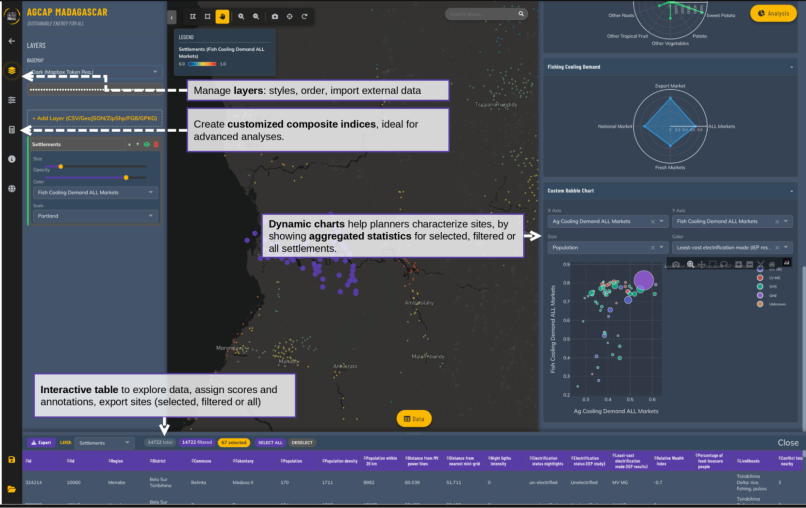
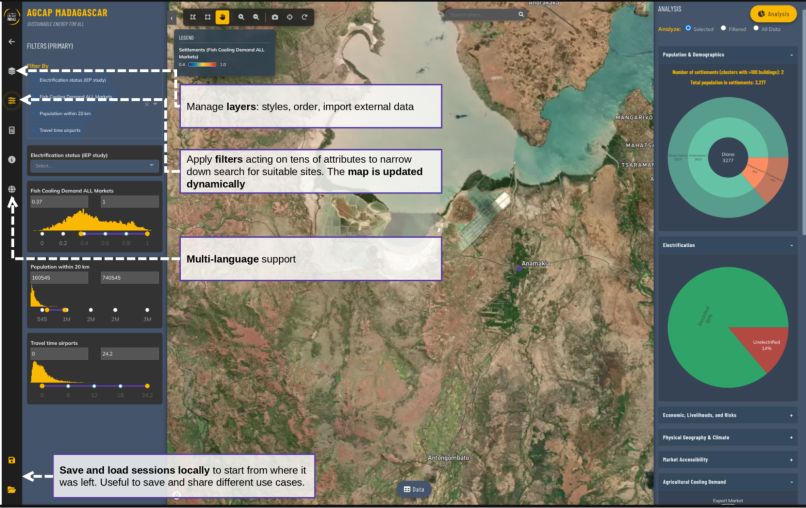
Government stakeholders can use the results of the multi-criteria analysis for site prioritization within energy access or electrification planning projects, like during the development of an Integrated Energy Plan. However, the results can also easily be tailored to and integrated into existing rural electrification plans or national electrification strategies. Moreover, government stakeholders in end-use sectors can use the results to ensure energy integration into their value-chain development projects, especially in value chains like fish, dairy and high-value horticulture products, and particularly in more sophisticated value chains. These results can then be integrated into existing sector-specific data platforms.
Similarly, development partners, NGOs, and private sector players in both the energy and agriculture sectors can use AgCAP to identify sites based on their specific project needs, such as value chain characteristics or geographical scope. They can use the national-level results, then refine and filter them to create a project-specific list of high-potential sites. This list can either be viewed and utilized in the online web interface or can be exported to develop project descriptions or reports.
AgCAP can thus be used to identify high-potential sites for agricultural cold storage tailored to specific use-cases. It should be acknowledged that numerous nuances arise when developing cold storage projects in rural development settings, and not all of them can be fully captured in an analytical model. The results can therefore be used to inform the prioritization of cold storage deployments, or identify high-potential energy access project sites, but it is required to complement them with a viability analysis based on the specific value chain dynamics to confirm the specific cold storage needs and viability of interventions.
The AgCAP Methodology is available here. The AgCAP Insights Platform is available at www.agcap-insights.org, and the code and documentation are at github.com/SEforALL-IEAP/AgCAP. Development of AgCAP and the preparation of the methodology document were supported by the Swiss Agency for Development and Cooperation (SDC).
Related content


