

Kisumu’s Race to Beat the Heat
On the shores of Lake Victoria, Kenya’s third-largest city, Kisumu, is facing a slow-moving climate crisis and emerging as a testing ground for urban heat resilience in sub-Saharan Africa.
By dawn, Kisumu is already moving. Fishermen haul tilapia ashore at Dunga Beach. Boda-boda motorbike taxis dart between the city's roundabouts, ferrying produce and passengers through thickening traffic. Traders fan out across the markets of Kibuye. For the more than 1.1 million people who call this lakeside county home, life runs on momentum. But the heat is slowing everything down.
Over the past two decades, Kisumu has recorded a steady climb in temperatures, with monthly averages now running more than 2°C above the baseline of the late 1970s. Fish spoils before it reaches the market. Hospital admissions spike during hot spells. Inside homes built with the iron-sheet roofing that covers 93.5% of Kisumu's housing stock, the temperature can still be climbing hours after sundown. At night, when relief should come, the walls radiate the day's accumulated heat back into cramped living rooms.
For a city where 64% of urban residents live in informal settlements, the consequences of extreme heat are not abstract. They are measured in lost income, sick children and sleepless nights. Projected climate trends offer little comfort. Rainfall is expected to increase by 42.1–51.5 mm annually, and combined with higher temperatures, added humidity will reduce the body's natural ability to cool itself, worsening heat stress even on days that fall short of the 37°C threshold.
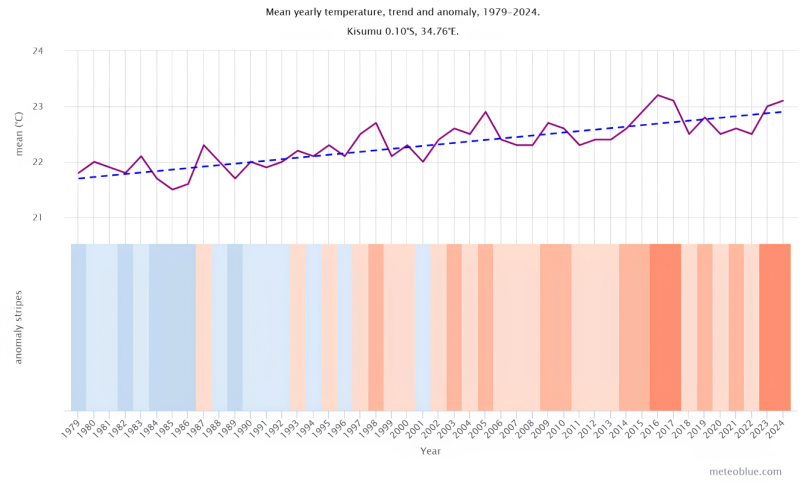
Figure 1: Kisumu annual mean temperature trend from 1979 to 2024, showing a warming of approximately 1.8°C over the period based on ERA5 reanalysis data. Meteoblue. Accessed May 2026.
A City on the Frontline
Kisumu sits at the western edge of Kenya, on the shores of Lake Victoria, and its geography has long made it a commercial crossroads. Its economy depends heavily on fishing and small-scale agriculture, sectors that together account for roughly 15.6% of Gross County Product. The county produces around 24,000 metric tons of fish annually, and nearly half of household incomes are tied to what farmers and fisherfolk can grow and catch.
Those livelihoods are increasingly precarious. Kenya loses an estimated 30-40% of perishable agricultural and fish products each year due to inadequate cold storage and broken cold-chain infrastructure, a figure that hits Kisumu disproportionately hard. When temperatures surge, the losses compound fast.
The public health picture is just as sobering. Analysis of hospital data from 2011–2020 reveals clear correlations between elevated temperatures and rising outpatient visits and admissions across respiratory, cardiovascular and infectious disease categories. Researchers have identified a Kisumu-specific heatwave threshold: when daily maximum temperatures exceed 37°C for more than three consecutive days, hospital systems feel the strain. Urban heat island effects, which cause dense informal settlements to retain warmth well into the night, make the burden heavier still.
Housing and Inequality
Kenya's 2019 census found that 80% of households nationwide live under iron-sheet roofing. In Kisumu, that figure rises to 93.5%. These thin metal sheets are cheap and widely available, which is why they dominate the housing stock in informal settlements like Nyalenda, Manyatta and Obunga. But they are thermally brutal: they absorb solar energy through the day and radiate it back through the night, turning homes into slow cookers.
Nyalenda A and B neighbourhoods, home to an estimated 5% of Kisumu County's population, two wards on the city's eastern edge, pack over 8,500 residential buildings into just 2.12 km², a density of more than 4,000 buildings per km². With an average height of just 5.18 metres – one to two storeys – the iron-sheet roof sits only metres above where families sleep, giving the heat it absorbs almost no distance to dissipate before it enters the home. Across the two wards, that amounts to nearly 530,000 square metres of heat-absorbing roof surface.
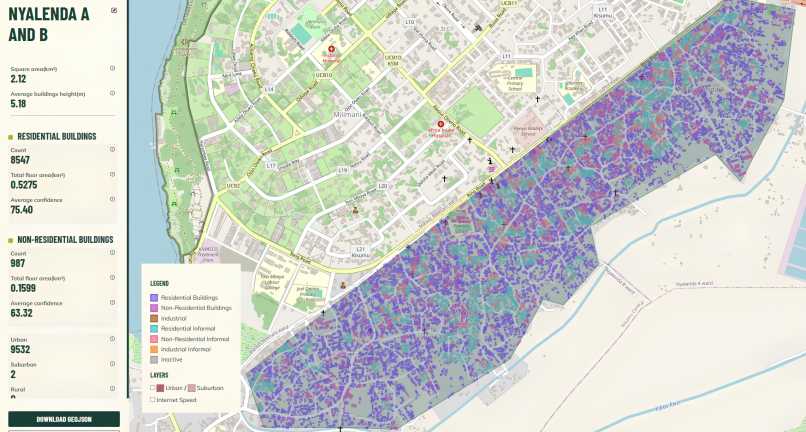
Figure 2: Building stock in Nyalenda A and B, Kisumu’s most densely settled informal wards. Source: SEforALL Open Building Insights (OBI), 2025.
Just 1.5 kilometres to the northwest, across Ring Road, the picture looks entirely different. Milimani, Kisumu's established formal neighbourhood, contains roughly a quarter of the residential buildings: 2,182 homes across 2.16 km², a density of just over 1,000 buildings per km². Buildings are taller on average, at 6.19 metres, with larger individual footprints and significantly more space between structures. Green parks, wider roads and tree-lined streets are visible throughout. In Milimani, there is one non-residential building for every 3.4 homes, more than twice the service coverage of Nyalenda. Two neighbourhoods, nearly the same size, less than two kilometres apart: one with four times the building density, lower roofs and a fraction of the green space. That gap, in density, in roof height, in green space, is where the heat inequality lives.
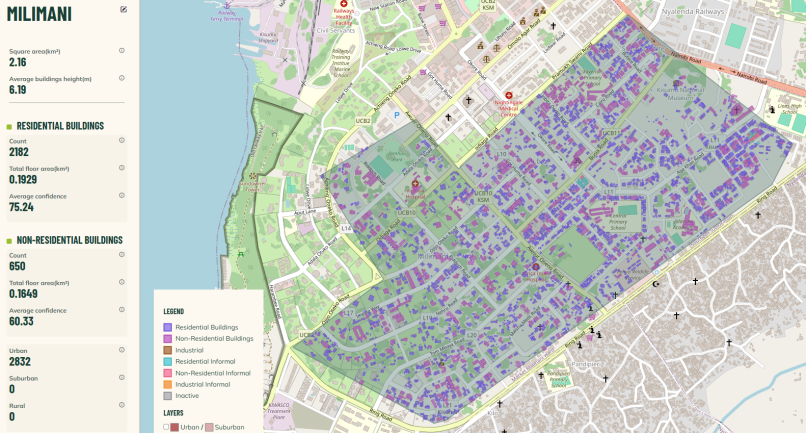
Figure 3: Building stock in Milimani, Kisumu’s formal residential neighbourhood. Source: SEforALL Open Building Insights (OBI), 2025.
The Plan
Addressing extreme heat in Kisumu is not only about forecasting heatwaves, it is also about reshaping the city’s fabric through shade, trees, cool roofs and better-designed public buildings that reduce indoor temperatures without driving up energy demand. A combination of active, passive and community solutions can produce significant benefits for Kisumu residents.
SEforALL is supporting Kisumu in developing its Heat Action Plan. The plan forms part of a broader national effort to address extreme heat, integrate cooling needs into County Energy Plans, and promote sustainable cooling solutions. It is intended to bridge national frameworks and local realities, ensuring that responses are tailored to county-specific needs while addressing immediate heat risks and strengthening longer-term energy and climate strategies, including the Kenya National Cooling Action Plan.
Felix Odhiambo Akello, is Kisumu County's Senior Energy Planner and Chief Heat Officer — one of the first officials on the continent dedicated specifically to extreme heat response. Akello has watched the weather become harder to read year by year; temperatures that used to build gradually now swing sharply, and rains that farmers once counted on arrive unpredictably or not at all. The weather is changing and it’s becoming increasingly difficult to plan for extreme weather.
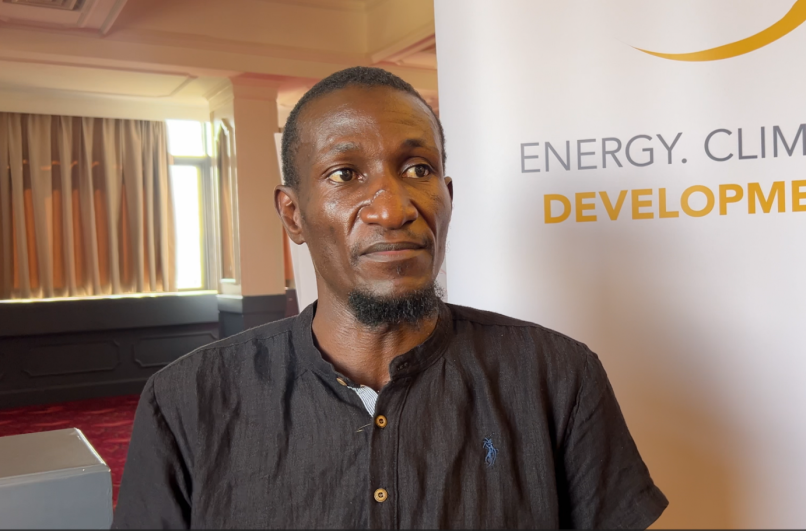
Felix Odhiambo Akello. Kisumu’s Chief Heat Officer.
Akello is the driving force behind Kisumu's Heat Action Plan 2025–2029. Rather than relying solely on emergency response, the plan targets the structural conditions that make Kisumu residents so exposed in the first place. Key interventions include:
- Cooling centres: Cooling centres in busy areas like Kisumu Central’s markets, hospital grounds and boda-boda (motorcycle) stages could give traders, patients and riders a place to escape dangerous heat during days above 37°C, especially in crowded neighbourhoods.
- Heat early warning systems: A heat alert issued across Kisumu when temperatures exceed 37°C for three consecutive days could help residents in Nyalenda, Manyatta and lakeside communities prepare early, adjusting work hours, staying hydrated and seeking cooler spaces.
- Passive cooling in buildings: In settlements like Obunga, Manyatta and Bandani, where homes are built with iron-sheet roofs, simple measures like reflective roofing and better airflow could make indoor spaces safer and more tolerable during hot nights.
- Cold storage for food systems: Cold storage at Dunga and Ogal Beach landing sites and city markets like Kibuye could keep fish and fresh produce from spoiling in the heat, protecting incomes for fisherfolk and traders who depend on daily sales.
- Urban greening and shading: Planting trees and creating shaded walkways along busy roads in Kisumu East and Central, where green space is extremely limited, could make it safer for people to walk, trade and commute under rising temperatures.
The plan also feeds into a broader national architecture. Kenya signed the Global Cooling Pledge, and its National Cooling Action Plan places sub-national governments at the centre of delivery.
The Funding Gap: Scaling What Works
For Akello, the stakes extend well beyond emergency management. He also oversees Kisumu County's 100% Renewable Energy Transition by 2050. The heat plan sits on top of that framework, pushing in the same direction: lower emissions, lower energy demand and lower exposure to climate risk. He is direct about what still stands in the way.
"Solutions must be designed so they are accessible to everyone," he says. "That requires inclusive policies and inclusive funding, not just pilot projects that reach a few neighbourhoods."
To ensure inclusive, well-organised and coordinated heat action planning, data collection is key. Yet support for acquiring monitoring equipment and appliances remains critically low, and awareness and capacity building are urgent needs as the city grapples with a rapidly growing population. Delivering on both fronts requires community health workers who are well-trained and equipped – the frontline actors who make sustainable, up-to-date heat data collection possible, and whose observations feed directly into decision-making.
Equally important is exposure and peer-to-peer learning. Active involvement at the local, national, regional and global level is essential to accelerate the sharing of best practices across geographies facing similar challenges. One of the starkest gaps, however, is in heat-related disaster preparedness: the county is actively seeking funding to establish a model, fully equipped cooling centre, a facility that would provide tangible, life-saving infrastructure when the next heatwave strikes.
The financing gap is real. SEforALL is working with Akello and counterparts in seven Kenyan counties to develop financing templates that could channel investment into the heat-resilience measures identified in the plan.
Authors:
Felix Odhiambo Akello, Chief Heat Officer of Kisumu
Rosa Garcia, Cooling Officer at SEforALL
Related content


