
Cooling access and heat mortality
SEforALL's Chilling Prospects analysis uses poverty and electricity access as measures for a population’s ability to afford or operate basic technologies to meet cooling demand, in countries where heat exposure is compounded by socioeconomic vulnerability. It estimates that over 1 billion of the world's rural and urban poor are currently at high risk of lacking access to cooling. This leaves them potentially vulnerable to illness and death, lost income, spoiled food, and unreliable access to medicines and vaccines. Figure 1 shows 53 countries identified as ‘high impact’ in the Chilling Prospects analysis, plotting people at high risk of lacking cooling access in the horizontal axis, against heat deaths in the vertical axis, color-coded by cooling degree days (CDD) as an indicator of cooling demand. These countries span a CDD range of 1,078-7,568 (base 18°C), roughly three to five times the global median, underscoring the fact that they include some of the world's most thermally stressed nations: inability to meet this cooling demand sustainably, due to poverty or electricity access gaps, could lead to chronic or acute heat exposure. There is a wide range in the number of heat deaths in 2023 in these countries. Timor-Leste experienced 6 heat deaths in 2023 according to the Global Burden of Disease study equal to 0.45 per 100,000 inhabitants, the second lowest relative death rate after Bhutan. On the other end of the spectrum, China was estimated to have experienced 50,329 deaths in 2023, although the highest death rates were experienced in Sudan (44 deaths per 100,000 people), Niger (31) and Mauritania (29). These numbers are likely to underestimate the true toll of heat exposure.
FIGURE 1: Mortality estimates, high -risk populations and CDD in Chilling Prospects high impact countries (2023).
Source: SEforALL analysis based on data from SEforALL Chilling Prospects 2026, Global Burden of Disease 2023, and the World Bank Climate Change Knowledge Portal.
Across the dataset, more deaths are seen in larger at-risk populations: those dying at disproportionate rates during extreme heat are likely to be the poor, those without reliable electricity, those in poorly ventilated housing or slums, and those with no access to mechanical cooling. However, the spread is substantial: countries with similar at-risk populations can differ tenfold in the number of deaths that occur, pointing to the significance of many additional factors like settlement characteristics, healthcare quality, early warning systems, and social protection.
The Sahel and Horn of Africa cluster of countries (Chad, Djibouti, Mali, Mauritania, Niger, Sudan) experiences very high CDD and consistently elevated rates of mortality, and hence represents the clearest convergence of high - and often unmet - cooling demand, large vulnerable populations, and high death rates. A South/Southeast Asian cluster (Bangladesh, Myanmar, Pakistan, Vietnam) has large at-risk populations and significant numbers of deaths despite moderate CDD, suggesting humidity and population scale amplify negative outcomes. A Sub-Saharan African cluster (Angola, Congo, Mozambique) has a surprisingly low death rate relative to its large at-risk populations, sitting well below the trendline and warranting scrutiny of data quality. In Nigeria, while the estimated 16,242 heat-related deaths represent a significant burden, the figure appears low relative to the country's large population at high risk (over 124 million, second only to India) and very high CDD (over 6,000). This discrepancy could point to higher physiological adaptation, but also to a potential underestimation of heat-related mortality. Egypt, Eritrea and Thailand sit well above the trendline, with small at-risk populations but high death counts, suggesting acute vulnerability concentrated in specific exposed groups. India is excluded from the chart, as the scale of its heat risks make it an outlier: its at-risk population (318.8M million) dwarfs that of other countries, and its total death count is the largest in absolute terms (210,000).
Overall, effective heat responses depend on enabling conditions: resilient infrastructure - including access to quality built environments and reliable electricity for all - robust public policy, and poverty alleviation are absolute prerequisites, without which communities cannot access or sustain cooling solutions. Emergency response protocols, early warning systems, and resilient healthcare infrastructure must also be in place for acute crises. Early warning systems, in particular, are essential but unevenly distributed: around 60% percent of Africa's population remains unprotected by any heat early warning system. He et al. (2025)[1] found most West African systems alert only on daytime maximum temperatures, missing nighttime heat, which the same study identified as the most significant driver of rising regional mortality.
With regards to heat resilience and sustainable cooling interventions, studies converge on a multi-scale framework spanning urban, building, and individual levels (see for instance Jay et al. (2021))[2]. The Global Cooling Watch 2025's "Cooling Access Tier" framework reflects this hierarchy (Figure 2). The key policy implication is that passive, low-energy cooling is not a "last resort" for those who cannot afford air-conditioning, but the most equitable, scalable first line of protection, especially in low-resource settings.
FIGURE 2: Tiers of access in residential comfort cooling.
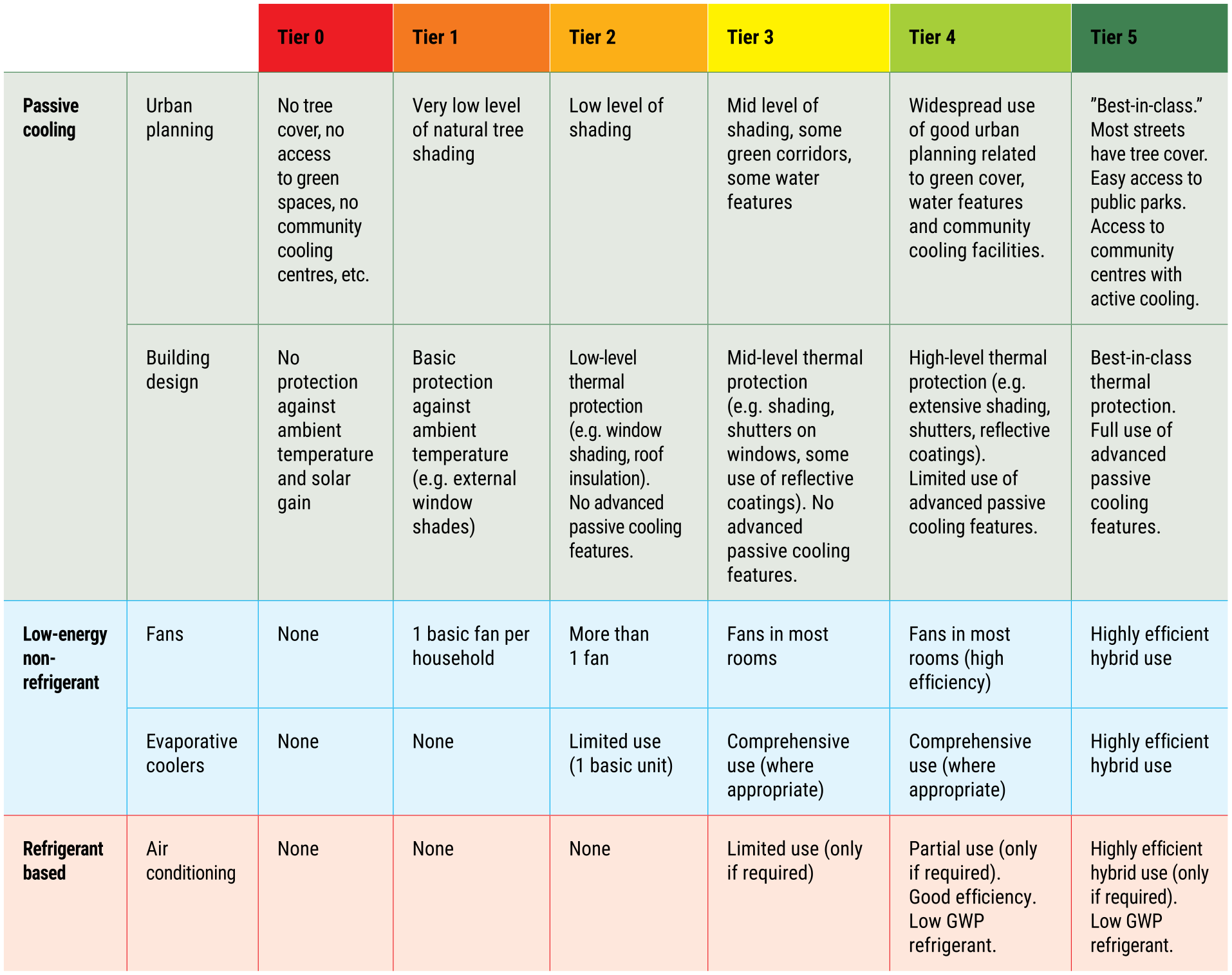
Source: UNEP Global Cooling Watch 2025


Notes and references
[1] He C, Zhu Y, Guo Y, Bachwenkizi J, Chen R, Kan H, Fawzi WW. Escalated heatwave mortality risk in sub-Saharan Africa under recent warming trend.
[2] Jay et al. (2021). Reducing the health effects of hot weather and heat extremes: from personal cooling strategies to green cities. The Lancet. 398, 709–724.