
Low-energy and mechanical solutions: an equitable approach
Electric Fans
Electric fans offer an affordable level of household cooling within reach of low-income households. In India, 90 percent of the population rely on fans as their only form of space cooling. [1] Electric fans - desk, stand-up and ceiling - provide effective cooling at less than 5 percent of the energy consumed by air-conditioning (AC), and a fan-first approach can reduce annual cooling energy demand by over 70 percent by enabling higher AC thermostat settings.
Recent evidence suggests fans provide cooling benefits on the vast majority of hot weather days globally, around 97 percent of hot days for young adults and 95 percent for healthy older adults, by facilitating sweat evaporation. [2] There are limits: fans do not directly reduce core body temperature in the way AC does, and their effectiveness diminishes at very high temperature and humidity levels. Official recommendations [3] set the safe-use temperature threshold at 35°C dry-bulb (especially for older adults), although other studies recommend up to 39°C for healthy young adults [4] with lower thresholds in very humid environments where sweat evaporation is limited. Within these boundaries, fans are appropriate year-round for the great majority of conditions experienced across Sub-Saharan Africa, South Asia and South East Asia (Figure 1). At night, when temperatures fall, fan use is almost universally beneficial for the nighttime recovery that emerging evidence identifies as one of the most important determinants of whether sustained heat exposure becomes fatal.
FIGURE 1: Where and when are fans effective at cooling people? Average monthly dry-bulb temperatures and fan effectiveness thresholds in four cities.
Understanding where fans become less effective helps identify where complementary solutions are most needed. The map in Figure 2 illustrates where this risk is greatest, using wet-bulb globe temperature (WBGT), a composite index that integrates air temperature, humidity and radiant heat into a single human heat stress indicator. On the WBGT scale, orange zones (25-30°C WBGT) encompassing most of Sub-Saharan Africa, South Asia and Southeast Asia in the June snapshot already indicate conditions where fans might face limitations. In extremely hot and dry conditions - parts of the Sahel, the Arabian Peninsula and inland South Asia - where air temperatures can consistently exceed approximately 40°C, low-cost evaporative cooling devices are a valuable and underdeployed complement that can extend effective cooling beyond what fans alone provide. In very hot and humid conditions, particularly on the hottest days in coastal humid regions of Bangladesh, Southeast Asia and West Africa, high ambient moisture limits sweat evaporation regardless of airflow, and shade, cool water and access to air-conditioned spaces become the priority for the most vulnerable groups.
These are specific and often time-limited exceptions, the hottest hours of the hottest days, not characteristics of entire regions or of typical conditions across the day and year. Promoting a fan-first approach requires updating heat health policies across healthcare facilities, workplaces, and formal and informal settlements to reflect the latest evidence, and ensure public communications support informed and confident use.
FIGURE 2: Wet-Bulb Globe Temperature (WBGT) across the world, June 16-20, 2026.
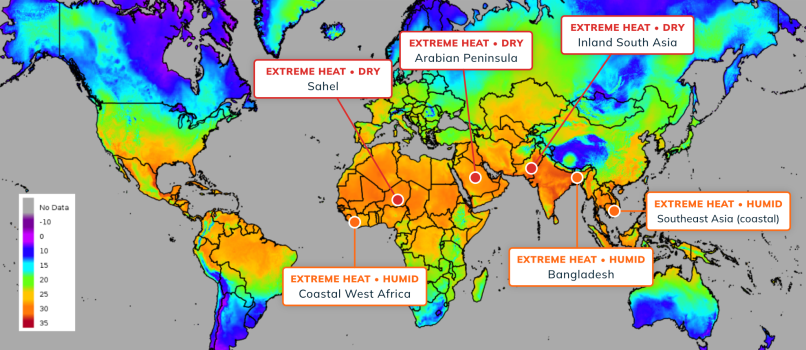
Source: CHIRTS-ERA5 experimental dataset, Climate Hazards Center, UC Santa Barbara.
Air-Conditioning
When ambient temperature and humidity combine to increase temperatures beyond critical thresholds, air-conditioning (AC) that lowers both air temperature and moisture levels becomes necessary for survival. However, many countries projected to experience the largest increases in heat mortality by 2050 are also projected to have the largest populations without AC. This can be because the electricity infrastructure to support active cooling at scale does not yet exist or because purchasing and operating an air conditioner remain unaffordable to most. Mitigating future mortality starts with investing in infrastructure today, including closing the electricity access gap and strengthening grid capacity to sustain growing cooling demand.
Figure 3 shows projected household AC ownership in 2050 under a moderate emissions pathway (SSP2-4.5, based on projections by Falchetta et al. 2024) and the projected net change in temperature-related mortality per 100,000 people by 2040-59 under RCP4.5 (UNDP Human Climate Horizons).
Countries in the top-left quadrant face the sharpest convergence of risks: rising heat mortality, low projected cooling coverage and large electricity deficits. Niger sits at the extreme, with a projected 64 additional deaths per 100,000 in 2050, only 22 percent AC ownership by 2050 and 21 million people off-grid today. Chad’s profile is almost identical (+47 deaths per 100,000 in 2050, 21 percent AC ownership by 2050 and 18 million people off-grid today). Nigeria, the largest bubble in the quadrant, adds a population dimension, with 87 million people currently without electricity. Globally, Falchetta et al. (2024) [5] project that even under optimistic scenarios, up to 4 billion people will still lack ACby 2050, with access deeply skewed by income and electricity infrastructure.
FIGURE 3: Projected AC ownership in 2050, projected change in heat mortality rate in 2050, and current electricity access deficit.
Source: SEforALL analysis based on data from Falchetta et al. (2024) for AC ownership (based on scenario SSP2-4.5), Climate Impact Lab (2025) for net projected change in mortality (based on scenario RCP4.5), World Bank (2026) for current electricity access deficit.
But the equity challenge runs deeper than access gaps alone. Low-income families who are often the most exposed to heat consume quantities of electricity that are similar to or higher than those consumed by higher-income families and which they are in less of a position to afford. In addition, where grids are fossil dependent, mass AC uptake exacerbates local air pollution and greenhouse gas emissions, again harming the poorest communities most. Unlocking AC ownership must therefore go hand in hand with grid decarbonization, targeted energy-affordability protections, and investment in energy efficient and passive cooling, so that the adaptation dividends are captured equally across communities.
Extreme heat and increased AC usage have compounding effects on grid stability, a severely under-analysed mortality amplifier. During heatwaves, grids fail through two main mechanisms: demand surges from cooling appliances, pushing distribution infrastructure beyond designed capacity, while simultaneously, elevated ambient temperatures impair transformers' ability to dissipate heat, accelerating insulation breakdown and triggering component failures even at loads that would be safe in cooler conditions.
The limited studies available find that, when grids fail during heatwaves, the consequences are severe: US data [6] shows that every additional hour of outage on a hot day increases heat-related harm by up to 61 percent, and when multi-day blackouts coincide with heatwaves, overall heat mortality more than doubles. The risk is not evenly distributed across the population. Analysis of Mexican municipal data [7]finds a clean correlation between local income and unplanned outage rates: richer municipalities experience significantly fewer disruptions, with coastal and tropical areas (with lower average income and higher exposure to extreme weather) facing particularly high outage incidence (Figure 4), indicating that grid reliability is systematically connected with local income levels.
FIGURE 4: Unplanned distribution grid outages in Mexico.
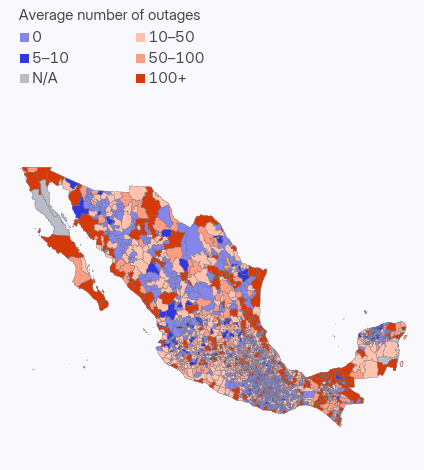
Source: Adelowo et al. (2026).
Comparing findings across different studies, several of the areas with elevated outage frequencies are in the states that ranked highest for heat-mortality impact [8] (including Campeche, Guerrero, Tabasco and Veracruz) (Figure 5).
FIGURE 5: Effect of extreme heat on mortality in Mexican states.
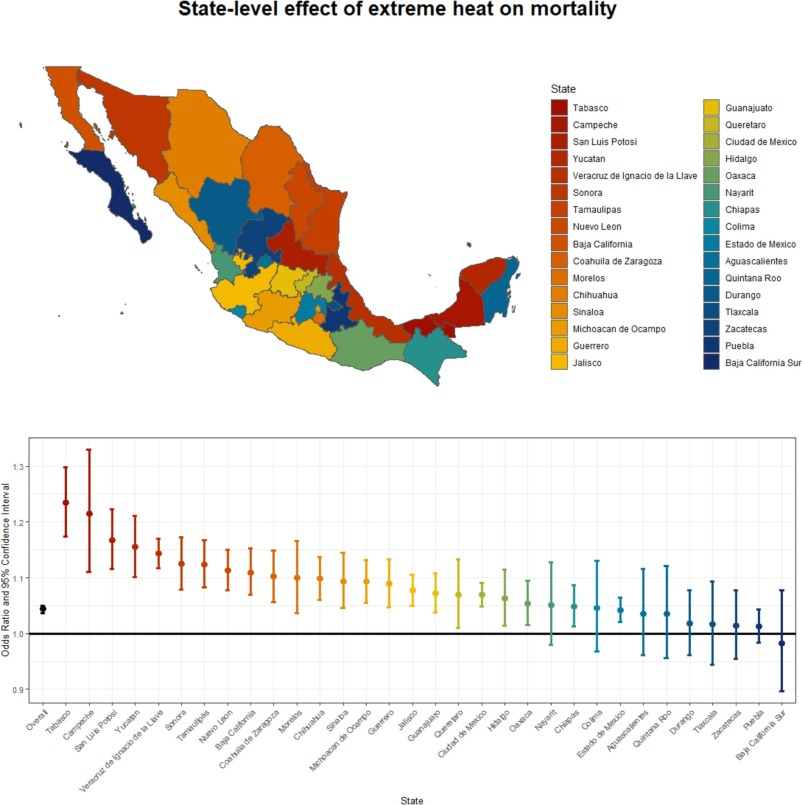
Source: Schwarz et al. (2025).
Energy efficiency and demand flexibility are important levers to address AC-related challenges. Minimum energy performance standards (MEPS) for cooling appliances offer a valuable lever here. In low-income markets, the cheapest fans and air conditioners are frequently the least efficient, running up operating costs and straining fragile grids. MEPS)establish efficiency baselines that address both issues at the same time: they lower the cost of running cooling appliances and reduce the peak demand that triggers grid failures during heatwaves. Demand flexibility and cooling can be addressed as interlinked opportunities: flexibility offers a further layer of resilience by enabling cooling loads to shift or moderate during grid stress events while, in turn, cooling can provide a form of energy storage to support greater flexibility.
Heat is more lethal when the people most exposed to it also lack shade, green spaces, well-ventilated homes, reliable electricity or affordable cooling. Hence, its effects need to be integrated into national health, climate and development strategies. None of these gaps can be closed by a single intervention. What the evidence points toward is a layered system: national cooling action plans (NCAPs) that include equity measures, heat action plans and early warning systems to ensure preparedness, passive design and urban greening as the first line of protection, fans and efficient appliances as the accessible middle tier, and mechanical cooling prioritized in the conditions where nothing else suffices, all underpinned by grid investment and efficiency standards. Investing in these solutions today will ensure heat resilience of the world's fastest-growing cities for the next half-century, and ultimately save lives.


Notes and references
[1] https://www.clasp.ngo/about/insights/making-efficient-affordable-fans-the-standard-in-india/
[2] Meade RD, Notley SR, Kirby NV, Kenny GP. A critical review of the effectiveness of electric fans as a personal cooling intervention in hot weather and heatwaves. The Lancet Planetary Health. 2024;8(4):e256–e269. DOI: 10.1016/S2542-5196(24)00030-5.
[3] Including WHO, CDC, NHS, backed by Meade et al. (2024) A critical review of the effectiveness of electric fans as a personal cooling intervention in hot weather and heatwaves. The Lancet Planetary Health. 8, e256–e269.
[4] Jay et al. (2023). "Fan-first" cooling – A low-carbon way to improve heat resilience in a changing climate [Policy brief]. Global Heat Health Information Network.
[5] Falchetta et al. (2024). Inequalities in global residential cooling energy use to 2050. Nature Communications.
[6] Behrer AP, Park J. Heat, power outages and mortality in the United States. Journal of Environmental Economics and Management. 2025. DOI: 10.1016/j.jeem.2025.103173. Available at: https://www.sciencedirect.com/science/article/abs/pii/S0095069625001597&
[7] Adelowo et al. (2026). Under Strain International Insights into Electricity Grid Outages.
[8] Schwarz et al. (2025). Heat-related mortality in Mexico: A multi-scale spatial analysis of extreme heat effects and municipality-level vulnerability.