
Passive and nature-based cooling: the first line of defence
Passive and nature-based cooling including architectural shading, natural ventilation, thermal mass materials, reflective surfaces and cool roofs, urban tree cover, accessible green spaces and cooling centres [1] can meaningfully reduce heat exposure at the district and household level without operational energy input, making them the most equitable first line of protection. The evidence is strong: cool roofs and reflective surfaces reduce indoor temperatures significantly, greening moderates the urban heat island effect (UHIE), and accessible green space draws people out of isolated, overheated homes, countering the social disconnection that makes heatwaves deadlier. Passive measures should always come first: by reducing the heat load that buildings and bodies have to manage, they lower the threshold at which fans and air-conditioning (AC) become necessary, reduce energy demand on fragile grids, and cut the operating costs that make mechanical cooling unaffordable for many. Locally responsive design, drawing on indigenous and vernacular building traditions that encode generations of knowledge about thermal comfort in specific climates, makes these solutions more effective and more likely to be adopted and sustained.
Yet, a rapid review of global media [2]suggests an awareness gap (Figure. 1): coverage skews toward energy-intensive, individual mechanical cooling solutions like air conditioners and refrigeration, while passive building and urban-nature solutions remain underrepresented. Employment and worker protection stand out as a distinctive South Asian media theme, largely absent elsewhere. But AC dominates heat-mortality reporting in all regions except West Africa, where coverage tends to stop at attribution.
FIGURE 1: Heat mortality in the news: samples of news covering heat mortality and cooling inequality during recent heatwaves in Europe, South and Southeast Asia, and Sub-Saharan Africa.
Source: SEforALL analysis
Practically, the gap between availability and actual access to cooling by the most vulnerable people is where many interventions fall short. The built environment illustrates this two-track challenge. Building energy codes - encouraging or mandating shading, orientation, insulation, ventilation - operate through formal development channels and reach only formally built, regulated housing. This is crucial given that, especially in emerging and developing economies, much of the building stock that will exist in 2050 is being constructed now, in fast-urbanising countries with weak or absent building energy codes, making the case for embedding passive design from the outset rather than attempting costly retrofits later. At the same time, for the hundreds of millions in informal settlements, where homes are self-built from heat-absorbing materials, codes offer no protection. The equivalent intervention here is slum upgrading: improving housing quality, cool roofs, shading, ventilation, water access, and service proximity in situ. Evidence is growing: a Rio de Janeiro study found slum upgrading reduced heatwave mortality by 3.9-5.5 percent in affected areas, offsetting nearly half of excess heat deaths there, through both direct cooling and sustained healthcare access during emergencies.[3]
Similarly, community-level cooling assets, such as shaded public spaces, cooling centres and urban tree canopy, can be inherently more inclusive than household-level solutions, because they do not depend on individual purchasing power or electricity connection. However, while these kinds of protection to extreme heat are well documented, they are also unevenly distributed: cities in the Global South have only about two-thirds of the cooling capacity and temperature relief seen in Global North, due to differences in both the amount and the quality of green infrastructure across these urban areas. [4]
Figure 2 maps 51 heat-vulnerable countries across four dimensions of urban heat risk: the share of urban residents living in slums (horizontal axis), urban greenery available for mitigating surface and air temperatures (vertical axis), projected growth in built-up area until 2035 and building code status (bubble size and colour, respectively).
Two stories emerge.
- In the upper-left quadrant, low slum shares combine with higher greenery (Dominican Republic, Egypt, Indonesia, Paraguay): the formal built environment is the main lever. Raising building code quality, including for affordable housing, is crucial, while also ensuring equal distribution of urban greenery.
- In the lower-right quadrant, high slum shares and low urban greenery converge: heat vulnerability is acute, and while sustainable building remains necessary, urban greenery and slums requalification become the most urgent protection strategies for marginalized populations. Large red and amber bubbles concentrated in this quadrant represent a pressing policy gap: fast urban expansion, weak or absent codes, high informality, and low greenery together. Chad, Congo, Mali, Niger and Somalia sit at this intersection.
FIGURE 2: Dimensions of urban heat vulnerability: urban vegetation, slum population, built-up area growth rate, and building energy codes.
Source: SEforALL analysis based on data from the Lancet Countdown 2025, The World Bank, UN World Urbanization Prospects, IEA/WB Building & Construction Green Dataset 2024; UNEP Global Cooling Stocktake Survey 2024.
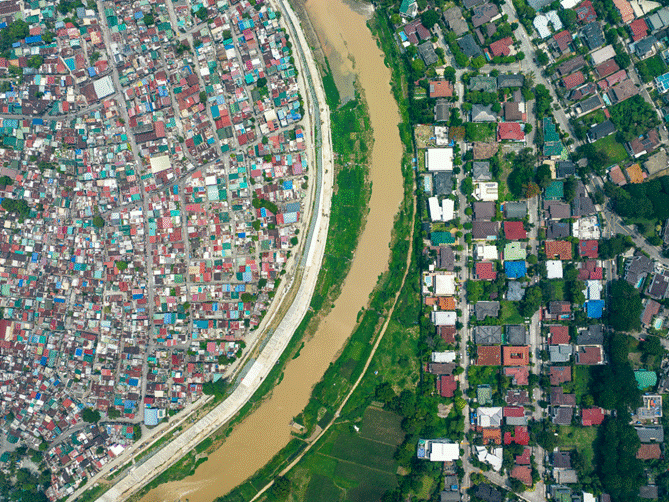
Within cities, green spaces, especially public parks, are often unevenly distributed, with the greatest shortfalls concentrated in dense, central neighbourhoods that have the highest population, levels of poverty and demographic need, while wealthier or low-demand fringe areas enjoy disproportionately higher green access. [5] Figure 3 offers a visual example of eastern Manila in the Philippines, where the Pasig River divides the low-lying, densely populated Malanday residential area from the prestigious, elevated Loyola Heights district.
Ultimately, cooling solutions developed with communities are more likely to be effective and sustainable than those delivered top-down. Experience from Jodhpur, India, shows that the uptake of community cooling is higher when spaces are familiar, accessible, community managed, linked to trusted community organizations and tied to everyday services.[6]
FIGURE 3: Unequal density of built-up area and urban green in eastern Manila.
Source: Unequal Scenes.


Notes and references
[1] Cooling centres can employ passive or active cooling measures. Importantly they are accessible spaces that provide relief from heat.
[2] The rapid content review analyzed approximately 60 English-language news articles, official reports, and peer-reviewed sources covering heatwave mortality and morbidity across eight countries in four regions (France, Spain, India, Pakistan, Thailand, the Philippines, Mali, and Burkina Faso) spanning heatwave events from April 2024 to June 2026. Explore further global media coverage by clicking the link in the text.
[3] Prosdocimi D, Klima K, DeYoreo M. Upgrading slums as a pathway to climate resiliency: evaluating urban infrastructure projects' impact on risk and health impacts during heatwaves. Preprint. Research Square. 2025. DOI: 10.21203/rs.3.rs-6516379/v1. Under review at npj Urban Sustainability.
[4] Li et al. (2024). Green spaces provide substantial but unequal urban cooling globally. Nature Communications.
[5] See for instance Tian et al. (2024). Urban green inequality and its mismatches with human demand across neighbourhoods in Amsterdam, Beijing and New York.
[6] Limaye, V. (2024). Jodhpur, India unveils a net-zero public cooling station. Natural Resources Defense Council.