
Why Women’s Leadership Is Key to a Just Energy Transition
In celebration of Women’s History Month and in honour of International Women’s Day 2026, Sustainable Energy for All (SEforALL) continues to champion women’s leadership as a driving force behind a just and inclusive energy transition, aligned with this year’s global theme: Rights. Justice. Action. For ALL Women and Girls.
The #EmPowerHer campaign recognizes that closing workforce, decision-making and funding gaps for women requires collective action. This includes dismantling systemic barriers, investing in women- and girl-led initiatives and creating clear pathways to leadership at all levels. Through the #EmPowerHer campaign, SEforALL champions equal energy access and participation #ForAllWomenAndGirls in the energy sector.
In line with our year-round commitment to empowering women and girls through collective action, we partnered with the World Woman Foundation at the 2026 World Economic Forum in Davos. Together, we convened two high-impact sessions at the gender-energy nexus, highlighting that advancing gender equality is critical to driving climate action and achieving sustainable growth.
Women’s leadership as a lever for action
The evidence is clear: empowering women yields powerful returns. Companies with more women on their boards are 60 percent more likely to reduce energy consumption and 39 percent more likely to lower greenhouse gas emissions. Countries with more women in parliament are more likely to have stricter climate policies and ratify environmental treaties. Companies with more women in senior management see a 30 percent higher return on equity.
Yet, women represent only 32 percent of positions in the renewable energy workforce and 22 percent of the traditional energy sector workforce, revealing a persistent gender gap in who shapes and benefits from the energy transition.
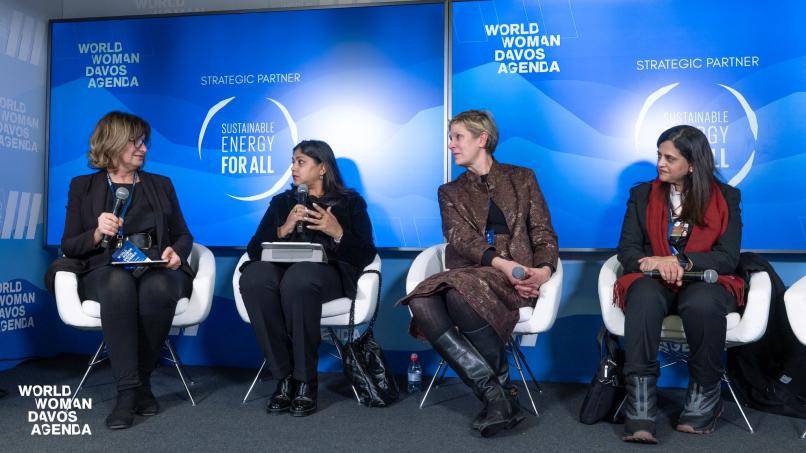
Empowered to Drive Growth: Women’s Leadership in Climate & Energy Action
On 19 January, 2026, the World Woman Davos Agenda session “Empowered to Drive Growth: Women’s Leadership in Climate & Energy Action,” moderated by international journalist Alina Trabattoni, highlighted that women’s full participation in decision-making is essential for sustainable development. Silvana Koch Mehrin, President & Founder of Women Political Leaders, informed that women’s political power remains the least improved dimension on the World Economic Forum's Global Gender Index, stressing that “who decides what’s going on in the room” determines the ambition of climate and energy policies.
Koch-Mehrin called for “deliberate leadership” to break the “concrete ceiling” in strategic portfolios, including energy, and to dismantle non-legal barriers that keep women out of top roles, including their overrepresentation in the care economy. She underscored that systemic change must be matched by individual action, saying, “Even without legislation, everyone can make a difference” and that equity in the energy transition starts at home.
Ashwini Bhide, Additional Chief Secretary to Chief Minister of Maharashtra, illustrated how women’s leadership transforms infrastructure and energy projects on the ground. She described low-carbon infrastructure initiatives in Mumbai implemented by teams of women leaders, noting that women-led projects tend to be more empathetic and socially inclusive. She spoke of the use of public policy to expand women’s economic rights, from access to finance to community councils to reserved procurement quotas that enable women’s groups to participate in clean energy value chains.
Vaishali Nigam Sinha, Co-Founder of ReNew, emphasized that women’s leadership is an economic imperative to reaching 2030 climate and energy goals. By driving a diversity agenda that has brought ReNew’s board to 40 percent women, Sinha showed how governance reforms can translate into value creation and stronger environmental, social, and governance (ESG) performance when diversity is tracked and reported to investors and employees.
“The push for the just energy transition needs to be global. It is not an option or belief, it is a reality that we need a just energy transition.” - Silvana Koch Mehrin
Powering On the Green Industrial Revolution: Closing the Skills Gap for the Energy Transition
On 21 January 2026, the session “Powering On the Green Industrial Revolution: Closing the Skills Gap for the Energy Transition,” moderated by Alina Trabattoni, turned attention to the workforce dimension of sustainable development. With the International Energy Agency projecting over 30 million clean energy jobs by 2030, ensuring that women and young people have the skills, networks, and recognition they need is central to meeting the demand for green talent.
Sarah Steinberg, Head of Global Public Policy Partnerships at LinkedIn, shared insights from LinkedIn’s global trends, noting that demand for green skills is growing twice as fast as supply. She emphasized that green capabilities are no longer limited to traditionally ‘green’ roles but are now vital across functions such as procurement, supply chain, and finance. Yet, women still comprise less than one-third of the global green workforce. Steinberg emphasized that “Workforce strategy needs to be an essential component of climate and energy strategy,” calling for a shift towards skills-based hiring to make the green transition more inclusive.
Yvonne Ruf, Senior Partner at Roland Berger, emphasized that investments in emerging markets must intentionally build local skills if the green industrial revolution is to be inclusive. “The transition of skills can happen successfully with government commitment and by bringing companies together. There exists more potential than is currently being leveraged,” Ruf noted. She urged governments and businesses to integrate skills development into procurement and investment decisions, plan transparently for which skills are needed, when and where, and support workers to retrain and access new opportunities in the low-carbon economy.
Both speakers highlighted that embracing a skills-based approach to talent development can open doors for underrepresented groups, including women, who traditionally face barriers to entry. This paradigm shift, they emphasized, is fundamental to creating equitable pathways for participation in the clean energy economy.
Turning advocacy into action
At the 2026 World Economic Forum, the message of SEforALL and the World Woman Foundation was clear: achieving a just energy transition is inseparable from advancing gender equality. Through its advocacy and partnerships, SEforALL continues to build global momentum for women’s full participation in the energy sector, empowering leaders, uplifting communities and driving progress towards a sustainable future for all.
Watch the session recordings:Empowered to Drive Growth: Women’s Leadership in Climate & Energy Action
Powering On the Green Industrial Revolution: Closing the Skills Gap for the Energy Transition


