
Rwanda’s Path to Cleaner and Safer Cooking Options
Across Rwanda, most households still rely on firewood and charcoal to cook their daily meals. These fuels harm people’s health, especially women's and children's, as cooking and caregiving often take place simultaneously. It is also time-consuming, as hours of the day will be spent on collecting firewood in the forest, often by women and children — time that women could otherwise devote to income-generating activities and children to studying or playing.
To address this, the Government of Rwanda has launched several initiatives to encourage the shift towards cleaner and safer cooking options.
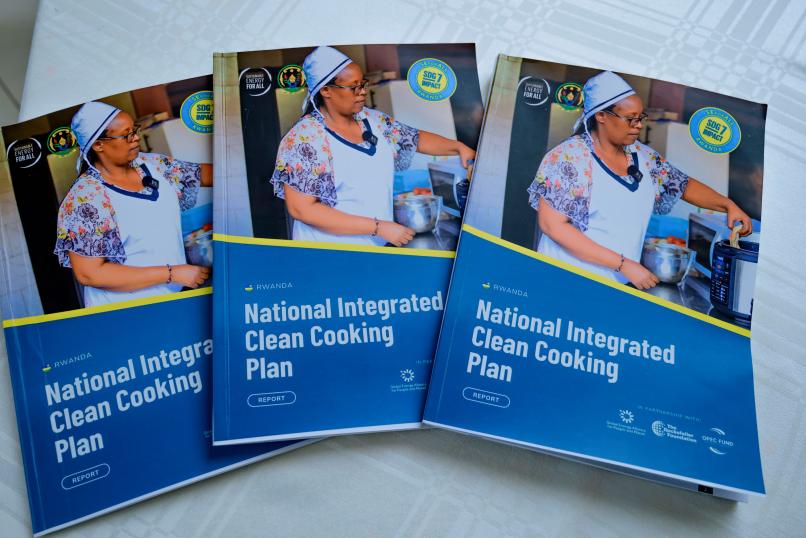
One such initiative is a National Integrated Clean Cooking Plan (NICCP), developed together with SEforALL, Universidad Pontificia Comillas, and Massachusetts Institute of Technology with funding from OPEC Fund, Rockefeller Foundation and The Global Alliance for People and Planet. It uses interactive tools to show how different decisions in relation to the cooking sector affect households, the environment and the economy over time.
"We have arrived at a milestone in accelerating clean cooking in Rwanda. Moving from traditional cooking fuels to clean cooking — such as electricity, gas, ethanol and others — improves the health of thousands of people each year and makes the cooking process more efficient. It will also help reduce greenhouse gas emissions and deforestation. The Ministry of Infrastructure welcomes the process of developing an innovative Integrated Clean Cooking Plan and reaffirms its commitment to evidence-based planning. We thank SEforALL, Universidad Pontificia Comillas and MIT for their collaboration. This initiative will guide coordinated efforts to achieve universal access to clean cooking across Rwanda."
Integration is the key
Rwanda has made strong progress on electricity access, but most households still rely on polluting cooking fuels. Expanding electric cooking can improve health and reduce emissions, but it also increases demand on the power system. Planning electricity access and clean cooking together ensures that investments reinforce each other, delivering cleaner cooking while building a power system that can support it.
The NICCP looks at how households adopt different clean cooking options, such as electricity and bioethanol, based on access, affordability, pricing policies and local conditions.
What are the key findings from the NICCP?
- Building infrastructure is not enough.
Even if electricity and other clean cooking fuels are available, many consumers may still struggle to afford clean cooking equipment and fuels (especially in rural areas). - Subsidies help more families switch.
When subsidies cover clean appliances and/or fuels, adoption increases, and the long-term investment needed from government and partners goes down due to economies of scale. The challenge is targeting these subsidies so they support households who need them most without placing unnecessary strain on public budgets — an approach informed by tools like the NICCP. - The cost of cooking for households should be monitored.
The tools assess how prices (including taxes and subsidies), household behaviour and economic growth interact, showing that a transition to clean cooking can be both affordable and deliver strong social benefits. - Strong private-sector support needed.
To meet national targets, the production/import and distribution of clean cooking products must scale up dramatically. This growth may be promoted by sustained policies that support sales expectations and, therefore, private investments. - Financing needs are large but manageable.
Rwanda’s clean-cooking transition will require several hundred million dollars in sustained investment over the next decade, rising toward around USD 1 billion as ambition increases. Most funding would come from concessional loans, grants, private investment and cross-subsidies, with additional potential from carbon markets, since clean cooking reduces CO₂ emissions.
This is what Rwanda needs to succeed
- Raise public awareness about the benefits of clean cooking.
- Strengthen coordination among national institutions and local actors.
- Expand training and capacity building for the production, sale, and maintenance of clean cooking technologies.
- Support local businesses to ensure sustainable supply chains and reduce reliance on imports.
- Design, disseminate and maintain stable integrated plans to attract public and private investments.
A major shift is possible
Rwanda has a strong foundation for a major shift in how its people cook. With integrated planning tools, financial support and sustained collaboration across sectors, the country can accelerate the adoption of clean, modern and affordable cooking solutions. Doing so will improve health, protect forests, support gender equality and contribute to climate goals, all while making daily life easier for millions of households.


