From Diesel to Solar. How Lincoln and Jelina are Powering their Businesses with Clean Energy.
A unique initiative implemented by Sustainable Energy for All is working with small-scale agro-processors in Zambia to boost their businesses.
Every day, many entrepreneurs across rural Zambia face the same challenges. Without access to reliable electricity, they crank up diesel generators to power their business operations. Using these generators increases operating costs and reduces profit margins while negatively impacting the surrounding environment. Fortunately, a new approach powered by solar mini-grids and suitable financing for productive-use equipment is improving businesses for entrepreneurs in rural Zambia.
Take the example of Lincoln Mumba, an entrepreneur from Petauke District in Eastern Province. In 2022, Lincoln bought a diesel-powered hammer mill and dehuller to start his milling business. He would mill maize for farmers for free and then sell the bran by-product to companies in Lusaka that make animal feed.
Last year, when his community was connected to electricity from a solar-powered mini-grid, he replaced his diesel-powered machines with new electric-powered ones with the support of Customised Energy Solutions (CES). With the new equipment, he doubled his production levels, and his earnings increased significantly. “From the extra income I am making, I am able to pay school fees and finance my farming activities,” Lincoln shared.
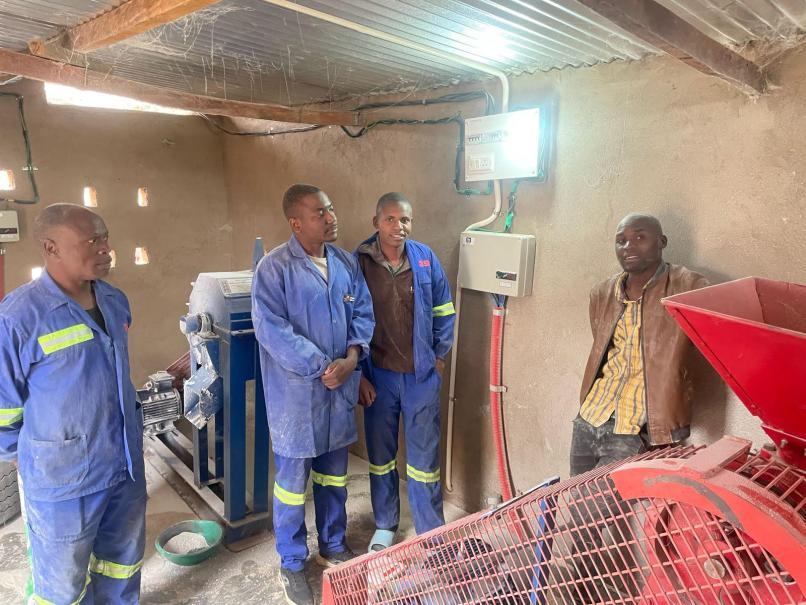
Lincoln recently acquired a solar-powered water pump from CES that increased his farm production. Today, he generates income from two sources with a combination of clean energy solutions.
Another beneficiary is Jelina Mwaula from Southern Province. She acquired a micro mill and a cold storage deep freezer for her growing agro-processing business. The micro-mill serves local customers who don’t have to travel long distances to mill their maize, while the cold storage unit preserves fish caught in the Kafue Gorge in Southern Province. With the storage, she is able to preserve and sell the fish locally, which increases both her revenues and minimizes losses associated with transportation costs. She acquired her equipment through a lease-to-own model and trained on basic operation and maintenance of the machines.
Through the CES Customized Applications for Rural Economies & Sustainability (CARES) program, the company is implementing a lease-to-own powered Productive Use of Energy (PUE) program to transform rural economies. They are supporting rural entrepreneurs to acquire PUE equipment with the option to pay for it over a 12-24 month period, with exceptions for large-scale irrigation, for which the repayment period is 30 months.
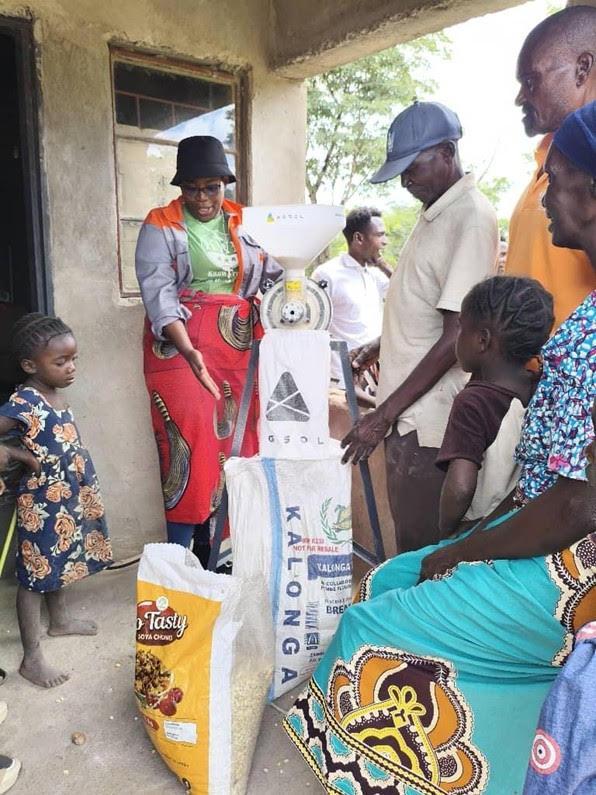
To benefit more entrepreneurs like Lincoln and Jelina, starting in April, CES began conducting PUE roadshows, showcasing over 60 livelihood technologies across 51 operational mini-grid sites in Eastern, Central, and Southern Provinces. The roadshows provide entrepreneurs with a chance to see and experience productive energy-use solutions firsthand.
CES’s work focuses on mini-grid scale up, energy access, and productive use, contributing to broader efforts to expand access and drive economic productivity in Zambia. This aligns with the Zambia Energy Demand Stimulation Incentive (ZEDSI) initiative led by SEforALL, alongside partners including the Global Energy Alliance, the African School of Regulation, and Columbia World Projects, with support from The Rockefeller Foundation.
This initiative is providing performance-based grants to mini-grid developers with the aim of pushing electricity beyond the household and into productive use like agriculture, milling, and commercial activities to drive sustained electricity consumption that improves their operating margins.
"Sustainable mini grids are built on demand, and demand is built on livelihoods. PUE is the catalyst that links clean energy to inclusive development. By enabling rural enterprises from agro-processing to cooling, PUE turns energy investments into engines of local economic growth and financial sustainability. Every productive appliance deployed multiplies community prosperity," said Nitin Akhade, the CES director of the Energy and Productive Economy Platform.
Through the ZEDSI initiative, SEforALL is addressing the most persistent challenge in mini-grid projects by solving the energy demand gap and enabling mini-grids to be profitable while delivering affordable electricity for businesses. The overall goal is to increase future investments in off-grid energy by linking generation and consumption, which is key to minigrids’ sustainability.
ZEDSI has made considerable progress catalyzing PUE adoption since the launch of the initiative in 2024. It has onboarded three private off-grid developers to install solar mini-grids across 43 rural communities and has been actively encouraging people and businesses to adopt PUE equipment and use electricity productively. Across these mini-grid sites, farmers are using milling and grinding machines to process their harvests, small businesses are running cold storage units, and households are charging phones and appliances.
ZEDSI is a catalytic financing facility that provides developers with results-based grants for connecting public institutions and productive uses of energy to new mini-grids. As of June 2025, the Facility awarded $1.1M worth of contracts to three developers representing 43 minigrid sites and an estimated 11,000 connections by 2027,” said Mukabanji Mutanuka, SEforALL’s Zambia Country Coordinator.
Early results show that customers supported under ZEDSI are using nearly eight times more electricity than those who are not. These mini-grid projects are also earning almost seven times more on average, thus increasing economic viability for the developers.
With these numbers expected to increase over time as more people are onboarded, ZEDSI is set for significant growth. As more entrepreneurs invest in PUEs, ZEDSI is demonstrating that businesses, and not just connections, are the best pathway to sustainable rural energy.
Sustainable Energy for All is a partner in the Agri-Energy Coalition, a global alliance of partners working on energy, water, agriculture, nutrition, climate and finance. It was created to unlock the potential of agri-food systems with clean energy.
Related content


