
What Happens When Women Are Part of Energy Planning?
By Wei Li — Project Officer, Sustainable Energy for All (SEforALL)
When we talk about energy transitions, we often focus on megawatts, finance and policies. But every transition ultimately affects people, from how families cook to who gets access to jobs in growing industries.
Through our Energy Transition and Investment Plans (ETIPs), Sustainable Energy for All (SEforALL) collaborates with governments to develop actionable roadmaps toward cleaner and more resilient energy systems. These plans help countries and regions align climate ambition with economic growth and financing strategies.
Gender is an important consideration in developing these plans. This is because the current energy system does not affect everyone equally. In many developing regions, women are primarily responsible for household energy tasks such as cooking, making them key energy managers within their homes and communities. Yet 2.1 billion people still lack access to clean cooking, exposing women and children to harmful indoor air pollution and time-consuming fuel collection. At the same time, women remain underrepresented in the energy sector, making up only about 20% of the global energy workforce and just 18% of senior leadership roles.
Expanding access to modern energy can reduce these daily burdens while improving health, saving time and opening opportunities for education, employment and leadership — enabling women to participate more fully as energy consumers, producers and decision-makers.
This is why gender is integrated across our energy planning activities, from developing ETIPs to capacity-building workshops. I have seen first-hand how gender is treated not just as an afterthought. It is intentionally considered in how opportunities are created, how jobs are supported and how investments are designed, ensuring women are both reflected in the plans and positioned to benefit from the transitions they enable.
Sierra Leone: Linking Energy Planning to National Gender Commitments
In Sierra Leone, gender integration reflects national priorities and commitments. The ETIP dedicates a full chapter to “Gender, Education & Youth,” aligning with the country’s Gender Equality and Women’s Empowerment Act, which mandates at least 30% representation of women in leadership across public and private sectors.
The plan connects this national commitment to concrete strategies. It proposes low-interest loans, grants and subsidies for women-owned and led sustainable energy enterprises, alongside gender-responsive incentives to support clean energy and transport adoption. It also calls for increased investment in STEM education to make it more accessible for girls, while recognizing women’s roles in agriculture and ensuring gender remains central to national climate policies.
Here, gender is integrated as part of a broader development and climate agenda, linking energy transition efforts with economic participation and leadership opportunities for women.
Powering Opportunity: Expanding Jobs for Women across ETIPs
Beyond policy design, ETIPs also highlight the economic opportunities created by the energy transition, including new jobs in renewable energy, energy efficiency and electricity access. Ensuring that women can access these opportunities is an important part of gender-responsive energy planning.
For example, the Sierra Leone ETIP projects nearly 30,000 new energy sector jobs, highlighting roles for women in installing, maintaining and managing 7,156 potential mini-grid sites. The Barbados ETIP estimates 1,500 new renewable energy jobs, urging companies to hire and retain more women. Ghana’s ETIP foresees 400,000 net additional jobs from the energy transition, emphasizing equal opportunities for men and women. In larger economies, the potential is even greater: Nigeria’s ETIP projects 840,000 new jobs, while Kenya’s anticipates 500,000 with women expected to play key roles in emerging clean energy industries.
Realizing these opportunities will require building the right skills for the transition. Across ETIPs, education and training are highlighted as key enablers, from integrating renewable energy topics into school curricula to expanding vocational training. Importantly, many initiatives focus on opening these pathways to women through STEM scholarships, targeted training and support for women-led enterprises.
From Plans to Participation: Capacity Building in Action
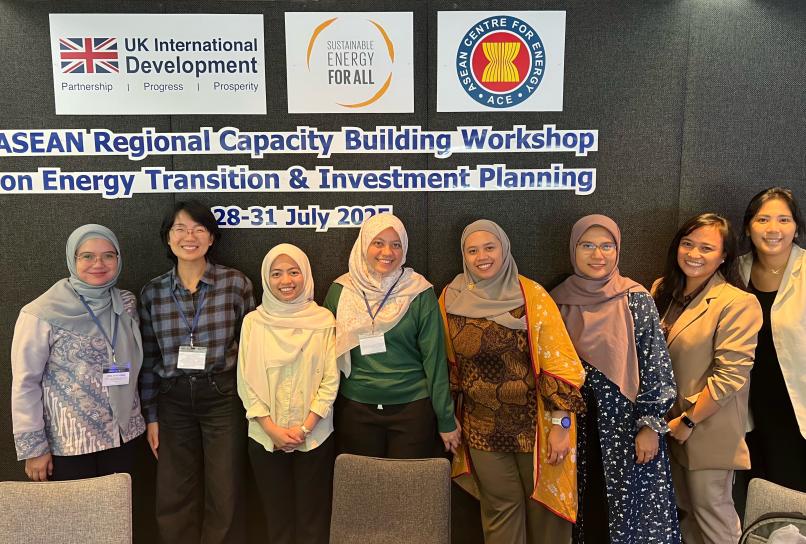
Our capacity-building workshops on energy transition planning are where strategies move from paper to practice. From the outset, we encourage participating governments and institutions to nominate women representatives, creating more inclusive spaces for technical energy discussions.
In our recent workshops in Manila (59% women participation), Bangkok (47% women participation), Vienna (43% women participation) and Kenya (52% women participation) — we saw strong female participation and impact.
They contributed to modeling discussions, scenario development and sector analyses, helping refine assumptions and priorities.Through hands-on exercises and technical discussions, they deepened their understanding of modeling and planning processes, strengthened their confidence to engage in national energy decision-making and gained the tools to continue contributing to their countries’ energy plans.
For me, this is where gender inclusion becomes tangible. It is not about creating leadership overnight, but about ensuring that women are present, heard and equipped to contribute meaningfully to decisions that shape their countries’ energy futures.
Related content


