2020 in review: A pandemic, renewed urgency on energy access and some optimism
About the author

Greater finance needed for gender-focused energy access initiatives
Sustainable cold chains needed for equitable COVID-19 vaccine distribution
Table 1: Leading vaccine candidates and their specifications as of 25 October 2020 [N/A: Anticipated temperature requirement for shipment and long-term storage is already 2–8 °C]
Universal vaccine access is already a major challenge in low- and middle-income countries in part due to the lack of fully-integrated, functioning cold chains. Key barriers faced, especially in low-income countries, include insufficient capacity, inefficient and unreliable cooling equipment, inadequate maintenance, insufficient monitoring of systems and products both in transit and when stationary, lack of relevant skills and appropriate training programmes, energy infrastructure deficits, and an absence of suitable financing and effective business models. Combinations of these barriers frequently result in distribution failures that lead to vaccine wastage, missed opportunities for vaccination and insufficient immunization programmes.
Figure 1 demonstrates the typical vaccine flow in routine immunization programmes and equipment found at different levels along the cold chain, from the point of manufacturer down to the health centres and outreach points where the vaccines are administered.
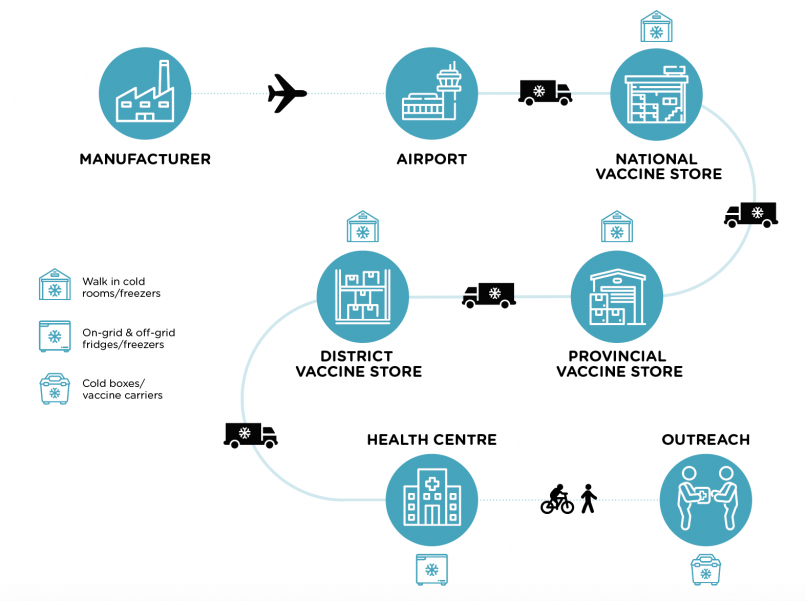
Figure 1: General structure of vaccine cold chain in routine immunization programmes
Estimates from 2013 suggest that 46 percent of health facilities in India and more than 30 percent of healthcare facilities in Sub-Saharan Africa do not have access to electricity. At the same time, GAVI, The Vaccine Alliance still estimates that only 10 percent of healthcare facilities in GAVI-eligible countries are equipped with adequate cold-chain equipment. Recent estimates also indicate that more than 25 percent of some vaccines may be wasted globally every year because of temperature control and logistics failures.
Even if this rate is halved for COVID-19 with new equipment deployments and a 10 percent wastage rate is achieved, it could still account for more than a billion vaccines wasted. The cost of current vaccines lost due to exposure to temperature fluctuations is estimated at USD 34.1 billion annually, not including the physical and financial costs associated with avoidable illnesses. The costs with a COVID-19 vaccine would be a multiple of this and ultimately it will be more cost effective to invest in adequate equipment.
Figure 2: Facilities with voltage fluctuations greater than +/- 15% (%). (The data were collected between 2009 and 2017 in 81 countries across all 6 WHO regions). [Adapted from EVM Global Data Analysis 2009-2018].
A multiple increase in cooling demand
Even in countries with robust vaccine programmes there are likely to be challenges in managing such a high volume of distribution. India for example has the world’s largest vaccine programme and distributes 400 million vaccines a year, immunizing 56 million people. The Indian Ministry of Health plans to initially immunize 200–250 million people against COVID-19 in six months once a vaccine is available. Assuming a two-dose vaccine, the programme would need 400–500 million vaccine doses, meaning the amount of COVID-19 vaccines to be delivered in six months is equal to the amount of vaccinations currently given annually. Achieving herd immunity would similarly require a three- to five-times increase in volume.
The challenge does not exist in isolation. Current vaccine campaigns must be simultaneously maintained. UNICEF and WHO estimate that up to 80 million children are at risk of missing out on vaccinations against vaccine-preventable diseases due to the pandemic. Capacity expansion must consider how to maintain existing programmes in consideration of the risks posed by vaccine-preventable diseases (VPD).
Outreach is a big challenge
Vaccinating the majority of the people in the world poses an extraordinary challenge to all countries but particularly to low- and middle-income countries where the existing cold-chain network is not capable of meeting current demand, let alone handling extraordinarily large quantities of the vaccine in a short space of time while maintaining existing immunization needs.
Furthermore, in low- and middle-income countries, a large proportion of the population live in rural, remote areas and many of the immunization services are provided via outreach. A key challenge for COVID-19 immunization will be last-mile distribution and ensuring that each vaccination site is equipped with both adequate fixed and outreach cooling equipment to maintain the efficacy of the vaccine. The success of the immunization will critically depend on delivering quality vaccines to every community, village and settlement. Geographical barriers and poor infrastructure — such as lack of transportation and bad road conditions — already place burdens on healthcare workers and reduce the ability to deliver frequent immunization sessions. Even in urban settings, using hospitals and other health facilities may not be feasible if they are already overwhelmed by the pandemic.
Figure 3: Vaccine stores that store vaccines at -20°C (%). (The data were collected between 2009 and 2017 in 81 countries across all six WHO regions). [Adapted from EVM Global Data Analysis 2009–2018].
Local conditions need to be understood
There is an immediate need to assess the capacity of vaccine cold chains globally and to put in place robust plans to bolster capabilities where necessary and take opportunities to improve the efficiency, performance and sustainability of these critical distribution systems. These include delivery mechanisms, technologies used and operational logistics, including management protocols, human resources and waste management.
While the volume of capacity expansion may be estimated considering population sizes, local conditions to sustain such expansion need to be fully understood, particularly at the “last mile.” Policy decisions on vaccine cold-chain expansion must assess: the potential of the existing vaccine cold-chain infrastructure to meet demand while maintaining current immunization services; the ability to sustain an expansion; the capacity to integrate modal shifts (drones for outreach) or novel technologies (mobile cold rooms and vaccine portable micro-chillers); the required energy supply; and the presence and appropriateness of alternative cooling facilities and energy sources.
And while each country is quantifying the number of health workers required to immunize its population, we must not ignore the fact that a lack of qualified engineers and mechanics, and inadequate training across the cold chain, will lead to long response times in the case of equipment malfunction, potentially increasing the proportion of broken cold-chain equipment at any point.
Opportunity for lasting legacy
The opportunity presented by an urgent demand for new cold chains and the re-engineering of existing ones to create a more sustainable low-carbon distribution infrastructure must not be missed. Indeed, as a contributor to green recovery and “Recover Better” policy agendas worldwide, all opportunities for incorporating efficient, sustainable cooling technologies and approaches into equipment procurement, optimization strategies and delivery plans must be maximized to the greatest extent possible.
While the cold chain is an integral part of achieving immunization targets, it comes with an environmental cost. Including both energy emissions (indirect emissions) and leaks of highly potent HFC refrigerant gases (direct emissions), one estimate suggests that cold chains are responsible for approximately 1 percent of global greenhouse gas (GHG) emissions and can represent 3–3.5 percent of GHG emissions in developed economies. Recent estimates also indicate that the healthcare sector is responsible for approximately 5 percent of global emissions, including refrigerants.
Older equipment used in cold chains can be unreliable and inefficient, while sustainable solutions for health facilities and transport can support COVID-19 vaccination campaigns now and contribute to greater resiliency over time. To minimize vaccine wastage due to unreliable electricity, vaccine programs should be supported by off-grid cooling equipment with temperature monitoring systems. Building on the work of GAVI, more financing for solar-powered refrigerators and freezers can support health facilities in developing countries that suffer from a lack of reliable electricity and often rely on polluting diesel systems. Efficient cold boxes, vaccine carriers and refrigeration units in vans can similarly reduce reliance diesel and high-global warming potential refrigerants.
Leapfrog to new solutions
Given that most of the technologies deployed today will still be in operation in the next decade, the recent emergence of sustainable and data-enabled cold-chain technology allows us the opportunity to leapfrog to sustainable solutions for COVID-19 vaccine deployment that can also deliver resilient and sustainable health cold-chain systems. At a minimum, it is imperative to recognize that new cold-chain capacity should not be based on technologies that are environmentally harmful and hinder the world’s ability to meet targets related to the reduction of emissions of GHGs and other pollutants. Better still, we should go further and leapfrog to new strategies that make progress toward the SDGs.
Drones are already proving their value for rapid delivery of pharmaceutical products in rural locations. Combined with new mobile rechargeable micro-chillers, they offer new integrated logistics solutions. At the same time, off-grid mobile cold rooms could enable more cost-efficient long-term campaign approaches. And we have the chance to embed real-time data capability across the system to ensure vaccine quality and chain of custody from the point of manufacture through to the point of delivery and help manage risks and breakages in the system in real-time.
In the short term, it will be the poor who will face the most significant challenges in accessing a vaccine for COVID-19. If a vaccine requires cold storage, sustainable cooling will become a serious issue of equity that underpins equal and fair access to it. As governments and NGOs develop distribution plans, cold chains must guarantee the health response and draw on the most sustainable solutions to build long-term resilience. This will impact all of us for decades to come.
Take action with the #ThisIsCool campaign. Find out more
