
Sustainable Cooling Access: Challenges and Opportunities for Agricultural and Fishing Communities in Sub-Saharan Africa
Sustainable Energy for All’s Chilling Prospects research series identifies more than 155 million rural poor across Sub-Saharan Africa who are at high risk of heat-related harm due to a lack of access to cooling [1]. This population not only lives in extreme poverty but also lacks access to electricity. Many rely on subsistence farming, yet have no access to cold chains that could help preserve produce and open up market opportunities.
Importantly, this high-risk group represents only a portion of the much larger rural population that could benefit from access to electricity and the cooling services it enables. Across Sub-Saharan Africa, around 450 million people in rural areas still lack electricity, and at least 70% of them are engaged in agriculture. This means that approximately 315 million people could stand to benefit directly from electricity-driven cooling and expanded cold-chain access.
Map 1: Risk groups and main risk factors by country (thousand people).
Improved access to cooling and cold chains can reduce agricultural post-harvest losses, ensuring more food reaches consumers, improving household nutrition, and strengthening the resilience of rural livelihoods. Of course, post-harvest cooling solutions are not a ‘silver bullet’. Rural African contexts are complex, and the challenges linked to sustainable adoption of agricultural cooling technologies will need to be factored into any proposed interventions. Nonetheless, there are several value chains where cooling solutions have repeatedly proven viable, particularly when deployed in mature ecosystems with organised producer groups and reliable off-taker markets. The most suitable and promising value chains for off-grid sustainable cooling include dairy, fish, and certain horticultural products.
Large cooling solutions located downstream in these value chains, like urban aggregation centers, are generally established by large private sector players, which already know where these solutions should be located as part of their business model. However, there is an underserved opportunity for more upstream cooling at a community level, giving local producers the chance to preserve their fresh produce and sell them at more mature markets, leading to improved livelihoods and nutrition. Geospatial data can be used to identify high-potential locations for these solutions. SEforALL is actively piloting such analysis in Madagascar, following the successful implementation of the Integrated Energy Plan, which included a high-level cold chain analysis.
SEforALL has developed the Agricultural Cold Chain Analysis and Prioritization (AgCAP) tool, which is an open source, customizable multi-criteria optimization-based cold chain prospecting tool. AgCAP complements the efforts of the Ministries of Agriculture, Fisheries and Energy as well as the National Statistics Institutes to identify communities most likely to benefit from cold storage solutions, enabling data-driven site identification and guiding commercial viability assessments to inform investment opportunities at the pre-feasibility stages.
Sustainable Cooling for Small Scale Fisheries in Madagascar
As post-harvest losses in Sub-Saharan Africa can reach 40%, and the absence of sustainable cold-chain infrastructure contributes to 526 million tonnes of lost food production every year, there is great potential for sustainable cooling solutions. Community-level cooling for small scale fisheries, including freezers and ice-makers are highly promising as fish spoils quickly.
Fish is one of the major sources of nutrition in Madagascar (65% of all national animal nutrition), and as 8.8 million people (33% of the population) were food insecure in 2022, there is a great opportunity to improve the nutritional intake of the Malagasy through improved preservation of the catch of small-scale fisheries. As part of Madagascar’s Integrated Energy Plan’s cold chain analysis, it was estimated that up to 80% of the fish production is lost at the producer level, one of the highest losses amongst the analyzed food chains. These losses can be reduced through the strategic deployment of ice-making machines and cold-storage solutions like local freezers or walk-in cold rooms.
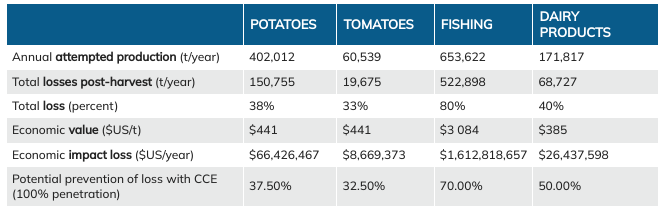
Madagascar, a country highly susceptible to various climate risks, especially floods and cyclones, also has sub-national regions that experience extreme heat (over 25 days/year of > 35° Celsius). The southern regions of the country are particularly susceptible to extreme heat and drought and coincidentally, these parts of the country are also responsible for a large share of the small-scale fisheries production. The region of Atsimo Andrefana, the second largest small-scale fisheries producing region in the country, experiences the most extreme heat days of the country. FAO estimates, based on the statistics of the Malagasy Ministry of Fisheries and Blue Economy (MPEB), that 59% of the overall 132.000 tons of fish annually originate from these small-scale fisheries12.The opportunity for sustainable cooling solutions in small-scale fishing communities is clear, especially in the southern regions experiencing extreme heat.
Map 2: Main Fishing Production Areas
There is a need for more granular analysis, that takes into account the nuances of local cooling solutions for agriculture and fisheries and that allows for data-driven project definition to derisk investments.
AgCAP leverages geospatial data analysis to identify high-potential sites at a settlement level, so that stakeholders can make evidence-based decisions on where to target prefeasibility analyses for cold storage investments. Moreover, the results identify settlements with high potential for Productive Uses of Energy (PUE) demand for cooling, which is currently often overlooked. The analysis takes into account agricultural and fisheries production at a settlement level, access to relevant infrastructure, proximity to local, national and international markets, and various other geographic parameters. These factors are combined into a Multi-Criteria Analysis that enables the ranking of settlement-level potential for cooling in a specific value chain.
As an indicative result, the map below shows the potential for cooling in fisheries value chains (both inland and marine) for local, national and international markets. This output has been used to target prefeasibility studies for cold storage solutions that will inform investments for food security in small-scale fishing communities. Furthermore it is envisaged that these results will guide impact investments of cold storage in fishing communities of locally managed marine areas. Above all, the analytical process has facilitated an intersectoral dialogue about planning for the energy demand of sustainable cooling in agriculture and fisheries.

Map 3: Fish Cooling Demand: All Markets
The results of the analysis identifies high-potential settlements for cooling in small fisheries all over the country, most notably in the highly productive fishing regions (Map 2). When combined with data on extreme heat and food insecurity, the southern regions stand out as opportunities for community cooling solutions to improve food security, especially Atsimo Andrefana, the second largest small-scale fisheries producing region in the country.
Data analytics provide a solid base for targeting cooling solutions, but it is crucial to note that this cannot address all the barriers to sustainable adoption. Identifying the right business model, market opportunities, operator of the technology and building the capacity and community engagement needed for a community cooling solution to succeed, need to be addressed after the identification of high-potential sites.
It is evident that local circumstances need to be taken into account when planning the deployment of off-grid cold storage facilities in order to avoid “white elephants”, stranded or underutilized assets. To achieve this, it is key to bring together both energy and agricultural / fishery value chain specialists to address this with an agricultural-energy nexus approach from the project planning phase onwards. The AgCAP process provides a crucial platform for such dialogue, as illustrated by the Malagasy pilot where a technical working group consisting of agriculture, fisheries, industry and energy stakeholders from the public sector, private sector and development partners jointly guide the pilot implementation.
SEforALL is committed to this approach by cementing its part in the Agri-Energy Coalition, with whom it advocates at a high level on the adoption of the nexus approach as demonstrated at the Coalition’s launch during the 2025 Africa Food Systems Forum.
With that nexus vision in mind, SEforALL is collaboratively implementing the AgCAP tool, as seen in the Malagasy pilot. SEforALL is currently scaling this approach to Mozambique as part of its support to the Ministry of Mineral Resources and Energy’s energy access planning initiatives, with future implementation slated for additional geographies.
Data analysis plays a vital role in identifying opportunities and unlocking investment, and can help stakeholder coordination to address the lack of cooling in vulnerable communities, as has been demonstrated through the IEP and AgCAP tools that SEforALL has developed.
[1] Countries included in Sub-Saharan Africa Analysis: Angola, Benin, Burkina Faso, Cameroon, Central African Republic, Chad, Congo, Côte d’Ivoire, Djibouti, Eritrea, Eswatini, Ethiopia, Gambia, Ghana, Guinea, Guinea-Bissau, Kenya, Liberia, Malawi, Mali, Mauritania, Mozambique, Namibia, Niger, Nigeria, Senegal, Sierra Leone, Somalia, South Sudan, Sudan, Togo, Uganda.
Related content


