
Chilling Prospects Data Story: Addressing the Dangers of Heat for Outdoor Workers
The tragic death of a Spanish street cleaner from acute heat stress in early 2025 underscored the escalating threat that extreme heat poses to outdoor workers. People working outdoors - such as street cleaners, vendors, agricultural and fisheries workers, and construction labourers - are at risk of heat-related illnesses, including heatstroke, dehydration, kidney dysfunction and neurological disorders. These risks are highlighted in a recent WHO and WMO study, which also reports that worker productivity declines by 2–3% for every degree above 20°C. With an estimated 1.6 billion outdoor workers globally, and daytime temperatures exceeding 20°C consistently across the tropics and during summers elsewhere, rising year-on-year alongside more frequent heatwaves, it is evident that extreme heat is undermining both the long-term health and economic security of workforces worldwide.
Figure 1: A large proportion of the 1 billion people at high risk due to a lack of access to cooling are likely to be made more vulnerable to heat due to working outdoors.
Heat disrupts the human body’s ability to maintain a stable internal temperature, normally around 37°C (98.6°F). The body cools itself mainly through sweating and the evaporation of sweat from the skin. However, when both air temperature and humidity are high, this cooling mechanism becomes less effective. Research suggests that a sustained wet-bulb temperature (a measure that captures both air temperature and humidity) of around 35°C is the upper survivability limit for humans; above this threshold, even healthy individuals resting in the shade struggle to maintain normal core body temperature and face a high risk of adverse health consequences. Lower wet-bulb temperatures can be dangerous for vulnerable groups such as the elderly, infants, those performing physical activity, or wearing work clothing that restricts the body’s ability to cool. The chart below indicates the liveability at varying combinations of air temperature and relative humidity, both indoors for 18 to 40 years (left) and over 65-year-olds (right) at various activity levels from seated to sustained activity.
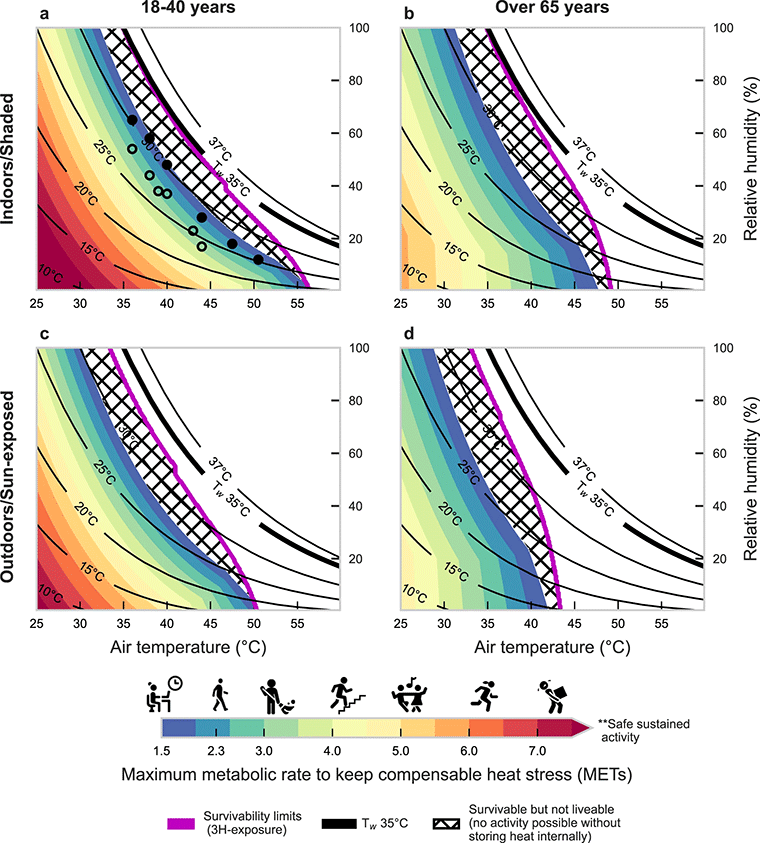
Figure 2: Estimates of liveability at varying combinations of air temperature and relative humidity for 18 to 40 years (left) and over 65 year olds (right) (Tw = wet bulb temperature, H = hours, MET = metabolic equivalents) (Source: Vanos, Jennifer & Guzman, Gisel & Baldwin, Jane & Bongers, Coen & Ebi, Kristie & Jay, Ollie. (2023). A physiological approach for assessing human survivability and liveability to heat in a changing climate. Nature Communications. 14. 10.1038/s41467-023-43121-5.)
Pregnant women are particularly vulnerable to extreme heat and their risk is heightened when working outside. A study of 92 pregnant farmers in and around Keneba, The Gambia, found that for every 1°C (1.8°F) rise in temperature, fetal stress increased by 17%. Given that women in Sub-Saharan Africa are often informally employed in agriculture (with an average female share of labor input into crop production of 40% in Ethiopia, Malawi, Niger, Nigeria, Tanzania, and Uganda) or engaged in outdoor domestic work, poor pregnant women are at high risk due to physical activity under intense heat.
In the countries assessed in the Chilling Prospects report, agriculture is a major employer of both men and women. In Mozambique, one of the Chilling Prospects Critical 9 countries, agriculture employed 69% of the population (World Bank) and 89% of women in 2023, whether formally or informally. The vast majority of the 17,724,000 Mozambican rural poor at high risk due to a lack of access to cooling are likely employed in outdoor agricultural work, making them highly vulnerable to rising temperatures.
Other sectors also face challenging and devastating situations. A Nature Cities publication finds that heat stress is responsible for productivity losses between 29% to 41.3% on construction sites. In the United States, construction workers are 13 times more likely to die from heat-related illnesses than workers in other job industries. As urbanization, infrastructure projects, and housing demand grow, the number of outdoor workers is only going to increase, and it is necessary to ensure health and safety measures are in place to protect these labourers.
For the 696 million urban poor at high risk due to a lack of access to cooling (Chilling Prospects, 2025), many are likely informally employed in outdoor work like street vending with their heat exposure exacerbated by the urban heat island effect. Greenpeace India and National Hawkers Federation’s Delhi-focused report Heat Havoc: Investigating The Impact on Street Vendors 2024 offers important data for policy makers and community action groups:
- 7 out of 8 women street vendors reported experiencing high blood pressure;
- 80% of street vendors observe a decline in customer numbers during heatwaves;
- 83% of street vendors have no guidance on how to handle heatwaves.
So, what can be done to protect outdoor works from extreme heat?
Protecting outdoor workers from extreme heat begins with awareness of their challenge and then understanding who they are, where they are, and what sectors they work in—both now and in the future. Farmers, construction labourers, and street vendors each face distinct challenges depending on their environment and economic circumstances. Effective protection requires data-driven insights, such as labour data collection and geospatial analysis, to identify high-risk groups, industries, and locations within a country or region. Yet such data is still notably lacking especially in low-income countries. Without it, policymakers and employers struggle to design tailored interventions or to ensure that heat action plans are truly responsive to the realities of outdoor work.
Outdoor workers need both timely information and practical means to respond to extreme heat. Heat action plans and early warning systems should include targeted guidance for outdoor workers - translated into local languages and shared through trusted community channels. On the ground, access to cooling is essential. Simple measures such as hydration stations, shaded rest areas, and cooled public rooms can make a major difference. For street vendors, markets and stalls designed with passive cooling strategies - like reflective white roofs, natural ventilation, and adequate shading - can greatly reduce exposure. In cities, efforts to reduce the urban heat island effect through planting trees, creating green spaces, and using reflective materials can help lower overall temperatures and make outdoor work safer.

Figure 3: An outdoor market structure incorporated with passive cooling measures including white roof, large openside for ventilation, roof vent and shading (generated with Gemini)
Given that many outdoor workers live on low incomes, it is also vital to improve basic services such as access to water and electricity. These not only protect health and wellbeing but also open opportunities for the productive use of energy, for instance, solar-powered fridges for perishable goods or a chilled drinks business.
Employers and contractors, particularly in construction and agriculture, have a key role to play by implementing clear heat health and safety policies. These should guarantee regular breaks, access to drinking water, shaded work areas and flexible hours during periods of dangerous heat. The ILO publication: Heat at work: Implications for safety and health: A global review of the science, policy and practice, provides guidance for workplace action on heat stress as well as a review on national policy responses to heat. The WHO and WMO report Climate Change and Workplace Heat Stress: Technical Report and Guidance is another useful resource.
Figure 4: Response guidelines to identify heat-related illnesses [1]
Over the longer term, social protection mechanisms - such as financial support or income guarantees during heatwaves - can help workers manage lost earnings and build resilience as the climate continues to warm.
Extreme heat is already endangering the health, livelihoods and productivity of millions of outdoor workers, who we all depend, and the response must now match the scale and urgency of the risk. Governments, employers, worker organisations, city authorities, health agencies and researchers must come together to create a coordinated heat action agenda that prioritises those most exposed, including workers in the informal economy who are too often invisible in policy and protection systems. This means urgently closing data gaps on exposure, illness, productivity loss and mortality through better monitoring and reporting, and using this evidence to set enforceable heat standards, early warning systems and worker protections. It also requires sustained investment in practical solutions—such as shade, cooling infrastructure, water and rest facilities, climate-smart urban design, and affordable protective equipment—alongside social protection and income security for those forced to stop work in dangerous conditions. Without decisive leadership, financing and collaboration now, extreme heat will continue to deepen inequality, undermine economies and claim lives that could and should be protected.
[1] Flouris, A., Azzi, M., Graczyk, H., Nafradi, B., and Scott, N., eds. 2024. Heat at Work: Implications for Safety and Health. A Global Review of the Science, Policy and Practice. ILO.


